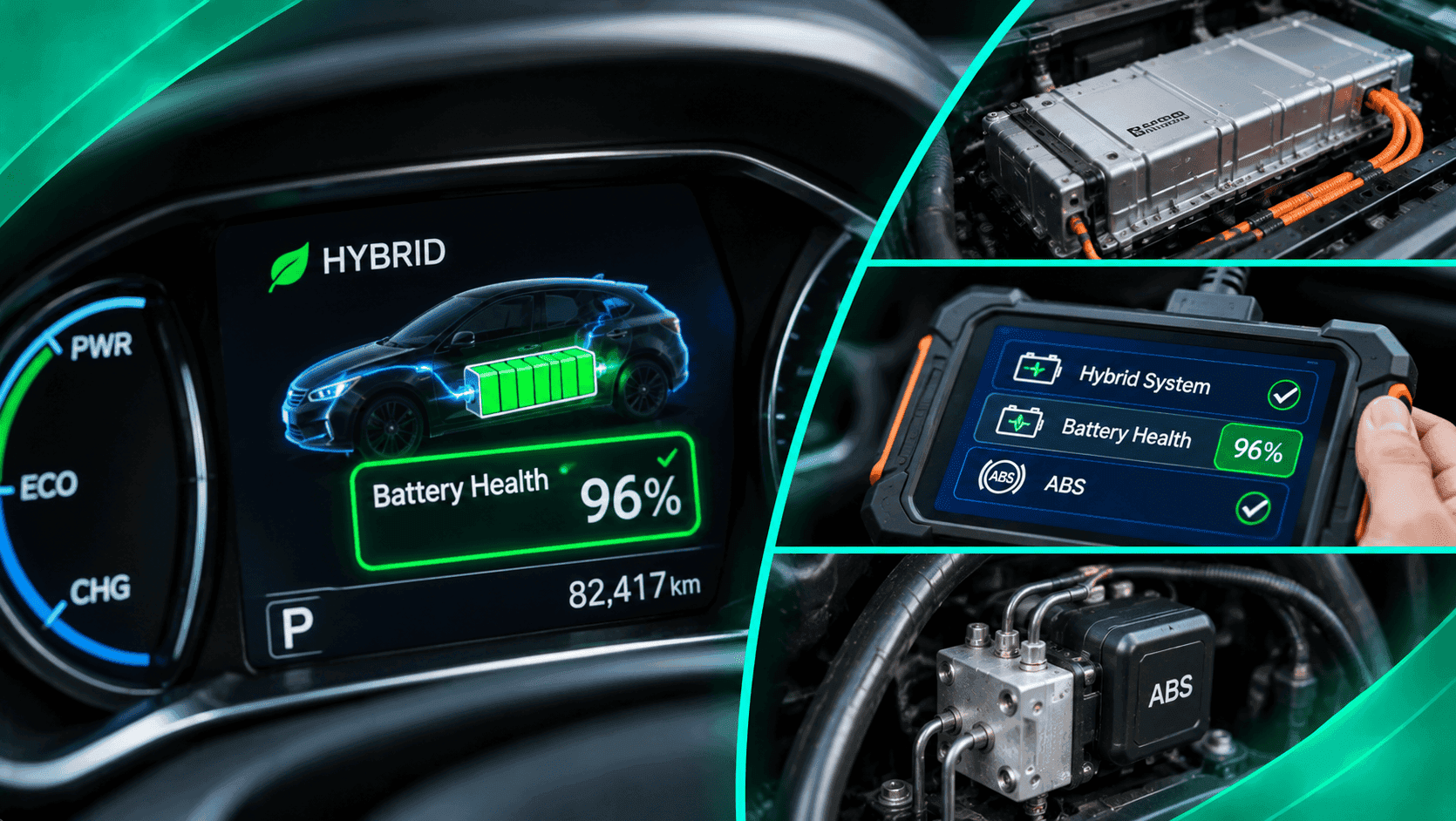
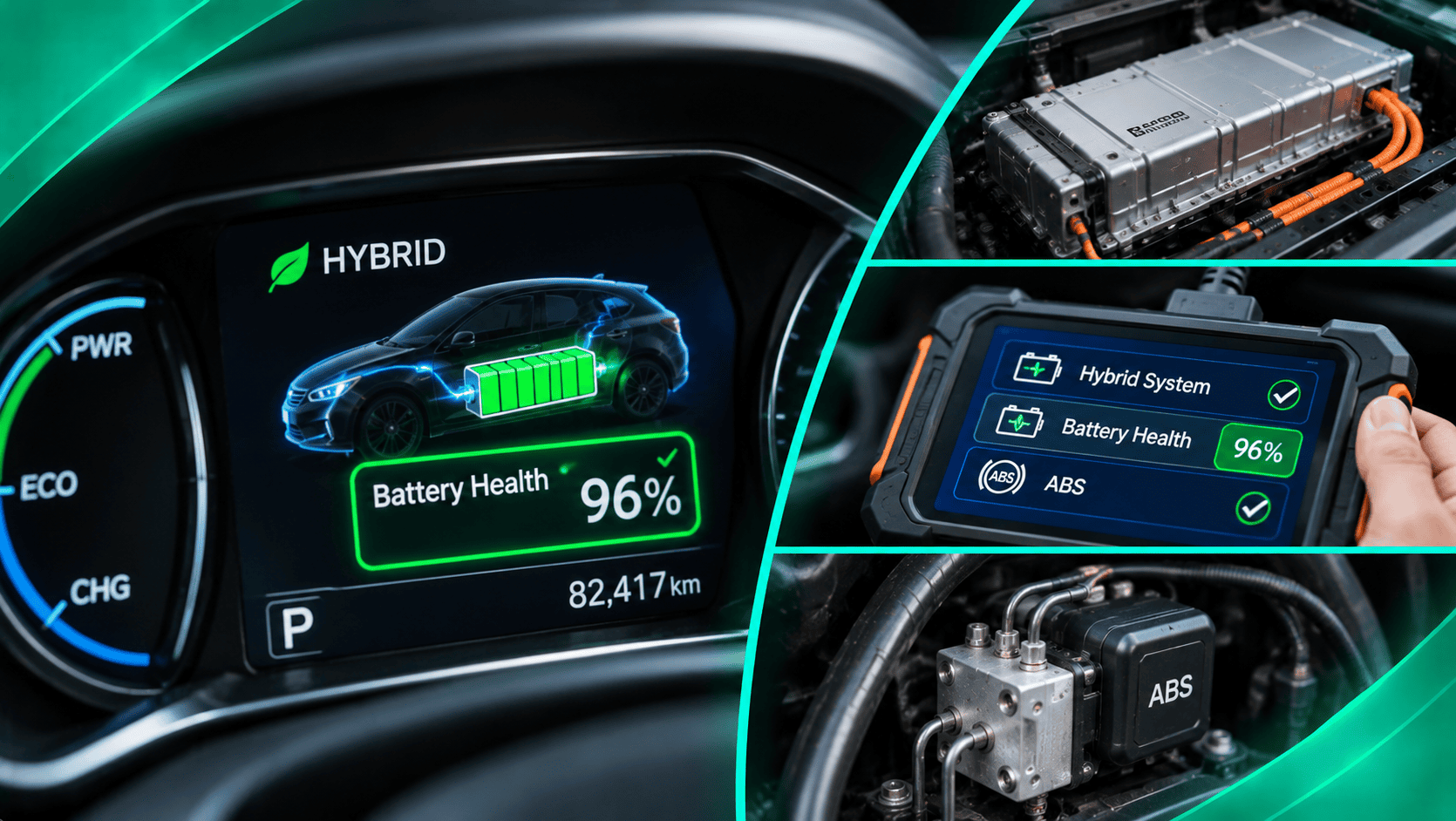
How to Check Hybrid Battery Health and ABS Before Buying a Used Hybrid Car

Today at MotorGuide, we're going to discuss two important systems that every buyer should inspect before purchasing a used hybrid vehicle in Sri Lanka. We're talking about the hybrid battery and the Anti-lock Braking System (ABS), including the electronic brake control components used in many hybrid vehicles.
Used hybrid vehicles remain popular among Sri Lankan motorists because of their fuel efficiency, everyday practicality, and suitability for city driving. Models such as the Toyota Prius, Toyota Aqua, Toyota Corolla Axio Hybrid, and Honda Vezel Hybrid are familiar choices in the second-hand market.
However, purchasing a used hybrid requires more than checking the exterior condition, mileage, and general engine performance.
The high-voltage hybrid battery and electronic braking system can be expensive to repair when major components fail. Depending on the model, condition, and availability of parts, unexpected repairs may cost a substantial amount of money.
That's why a proper pre-purchase inspection is particularly important.
So, how can you check hybrid battery health, recognise possible ABS problems, and avoid purchasing a vehicle with expensive hidden faults? Let's take a closer look.
Why Are Hybrid Battery Health and Brake System Condition So Important?
A hybrid vehicle combines an internal combustion engine with one or more electric motors and a high-voltage battery.
The hybrid battery stores electrical energy that can be used to assist propulsion and support the vehicle's hybrid operating functions.
During driving, the battery is charged and discharged according to the demands of the hybrid system.
Over time, its usable capacity and performance may decline because of age, temperature exposure, repeated cycling, and other operating conditions.
At the same time, many hybrid vehicles use sophisticated electronically controlled braking systems that coordinate conventional friction brakes with regenerative braking.
Faults affecting the brake actuator, booster, accumulator, sensors, or associated control systems can create both repair costs and safety concerns.
However, hybrid battery designs and brake system arrangements vary between manufacturers and models. The inspection procedure for a Toyota Prius should not automatically be applied to a Honda Vezel or another hybrid model.
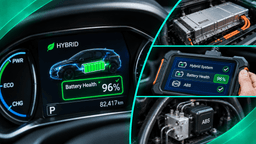
1. Check the Hybrid Battery Display During a Test Drive
One of the first things many buyers examine is the hybrid battery charge indicator on the dashboard.
Depending on the model, the display may show several battery bars representing the estimated state of charge.
During normal hybrid operation, these bars may increase as the battery receives energy from regenerative braking or engine-driven charging.
They may decrease when the electric motor draws energy from the battery.
However, the dashboard battery display is not a direct measurement of overall battery health.
A battery with reduced usable capacity may still show a full or nearly full charge indication.
Some deteriorated batteries may also appear to charge and discharge rapidly because they have less usable energy storage capacity.
During a test drive, observe whether the displayed charge level changes unusually quickly during ordinary driving.
For example, if the battery indicator repeatedly drops sharply and the petrol engine starts unusually often to replenish it, the battery may require further investigation.
However, the petrol engine starting frequently is not by itself proof of battery failure.
Hybrid vehicles may start their engines because of air conditioning demand, battery temperature, operating temperature, driving conditions, or normal hybrid system management.
Therefore, rapid fluctuations in the dashboard display should be treated as a possible warning sign rather than a confirmed diagnosis.
2. Listen for Unusual Hybrid Battery Cooling Fan Noise
Another useful check involves the hybrid battery cooling system.
Many hybrid vehicles use a dedicated cooling fan to move air through or around the high-voltage battery assembly.
Depending on the vehicle, the cooling air intake may be located near the rear seats, beneath a seat, or within another interior panel.
When the battery temperature rises, the system may increase fan speed to help control its operating temperature.
Some fan noise during normal operation is expected.
However, a cooling fan that repeatedly operates at unusually high speed may indicate excessive battery temperature, restricted airflow, heavy battery demand, or another problem requiring inspection.
Dust, lint, and debris can accumulate in the cooling intake or fan assembly over time.
This is particularly relevant for vehicles frequently used in dusty conditions or those carrying passengers and luggage that may obstruct the cooling vents.
Before purchasing, inspect accessible battery cooling air intakes and ask whether the cooling system has been maintained.
However, loud fan operation alone does not confirm that the battery cells are damaged.
A specialist should check battery temperature readings, cooling fan operation, and the condition of the intake system before drawing conclusions.
3. Use a Hybrid-Compatible Diagnostic Scanner
One of the most important steps in a used hybrid inspection is performing a diagnostic scan with equipment capable of communicating with the hybrid control system.
A basic OBD-II scanner may only display general engine-related fault codes.
It may not provide access to the hybrid battery control module, brake control module, or detailed manufacturer-specific diagnostic information.
For this reason, a hybrid-compatible diagnostic tool is preferable.
For certain Toyota hybrid models, specialised applications such as Dr. Prius may provide useful battery-related information when used with a compatible OBD adapter.
However, software compatibility and the available diagnostic features depend on the exact model and production year.
A professional diagnostic system can provide access to relevant fault codes and live operating data, allowing the technician to evaluate the vehicle more thoroughly.
4. Compare Hybrid Battery Block Voltages
In many hybrid battery systems, diagnostic software can display voltage readings for individual battery blocks or monitored battery groups.
These readings help technicians assess whether sections of the battery are performing consistently.
When the battery is operating normally, block voltages generally follow similar patterns under comparable conditions.
If one block repeatedly shows significantly different behaviour under load, this may indicate deteriorated cells, excessive internal resistance, or another battery-related fault.
However, a difference in block voltage does not always mean that the entire battery must be replaced.
Some Toyota diagnostic procedures refer to voltage differences around 0.3V in particular testing conditions, but this is not a universal replacement threshold for every hybrid vehicle.
The correct interpretation depends on the battery design, state of charge, operating load, temperature, and manufacturer diagnostic specifications.
Voltage readings should therefore be evaluated using the appropriate testing procedure rather than relying on a single measurement.
For example, a technician may compare battery block behaviour during acceleration, regenerative charging, and controlled diagnostic tests.
Consistent abnormal readings, particularly when accompanied by relevant diagnostic trouble codes, deserve further investigation.
5. Check Battery Internal Resistance and State of Health
Battery internal resistance is another useful diagnostic measurement.
As a battery ages or deteriorates, its internal resistance may increase, affecting its ability to deliver or accept electrical power efficiently.
Some hybrid diagnostic systems provide estimated internal resistance values for battery blocks.
A technician can compare these readings with the manufacturer's specifications and evaluate whether particular blocks show abnormal behaviour.
Another term buyers may encounter is State of Health, commonly abbreviated as SOH.
SOH generally refers to an estimate of a battery's condition compared with a defined reference state.
However, different manufacturers and diagnostic applications may calculate or estimate battery health in different ways.
A battery health percentage shown by a third-party application should not automatically be treated as a manufacturer-certified measurement of remaining battery lifespan.
Similarly, a reading below 60% does not represent a universal threshold that proves every hybrid battery requires replacement.
The correct decision depends on the battery type, diagnostic method, actual performance, fault codes, and repair options.
For a used hybrid purchase, it is better to obtain a detailed battery inspection report than rely on a single percentage.
6. Check for Hybrid Battery Fault Codes
A proper diagnostic inspection should also include a scan for stored and current hybrid system fault codes.
Some Toyota hybrid vehicles may record codes such as P0A80 when the battery control system detects conditions associated with battery deterioration.
Other codes may relate to battery cooling, voltage monitoring, communication problems, or hybrid system performance.
However, fault code definitions and diagnostic procedures vary between manufacturers.
A stored code does not always mean that the corresponding component requires immediate replacement.
For example, certain voltage-related faults may involve electrical connections, monitoring components, or other hybrid system problems.
A qualified technician should inspect live data and follow the relevant diagnostic procedure before recommending repairs.
7. Why Is ABS Inspection Important in a Used Hybrid?
The Anti-lock Braking System helps prevent wheel lock-up during certain braking conditions, allowing the driver to maintain better steering control.
Many hybrid vehicles also use regenerative braking to recover some of the vehicle's kinetic energy and store it in the hybrid battery.
Depending on the model, the brake control system coordinates regenerative braking with conventional hydraulic braking.
Some Toyota hybrid models use electrically controlled brake boosters, brake actuators, hydraulic accumulators, and associated electronic control systems.
These assemblies are more complex than the braking systems used in some older conventional vehicles.
If a major brake actuator or booster component fails, repairs may be expensive.
However, the cost depends on the vehicle model, the exact component, whether a new or remanufactured unit is used, and local parts availability.
Therefore, a fixed repair estimate such as Rs. 200,000 to Rs. 400,000 should not be considered accurate for every hybrid vehicle in Sri Lanka.
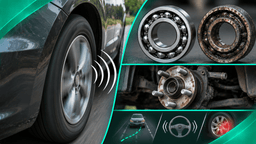
8. Check the ABS, Brake and Traction Control Warning Lights
One of the first brake system checks should be performed before the test drive.
When the ignition is switched on, observe the dashboard warning lights.
Depending on the vehicle, indicators associated with ABS, the braking system, traction control, and stability control may illuminate temporarily during the system's self-check.
After the system completes its checks, the relevant warning lights should behave according to the manufacturer's specifications.
If an ABS or brake warning remains illuminated, further diagnosis is necessary.
However, the warning light sequence is not identical on every hybrid model.
Some indicators may behave differently depending on whether the ignition is on or the hybrid system is in READY mode.
Therefore, buyers should compare the warning light behaviour with the owner's manual rather than relying on one universal sequence.
Also, the absence of an illuminated warning light does not guarantee that the brake system is fault-free.
A complete diagnostic scan is important because some faults may be stored in the control module even when the dashboard appears normal.
9. Listen for Unusually Frequent Brake Actuator Pump Operation
Another useful inspection involves listening for the brake booster or hydraulic accumulator pump on vehicles equipped with this type of system.
In certain Toyota hybrids, the electrically driven pump helps maintain hydraulic pressure required for brake operation.
The pump may produce a brief buzzing or humming sound during normal operation.
For example, it may operate when the vehicle is prepared for use or after the brake pedal has been pressed.
However, if the pump runs unusually frequently while no brake input is being applied, it may indicate that the system is struggling to maintain hydraulic pressure.
Depending on the model, possible causes include internal fluid leakage, accumulator deterioration, pressure sensor problems, or other brake control faults.
Some Toyota diagnostic procedures specifically identify frequent pump operation without braking as a possible sign of an accumulator pressure-related problem.
However, hearing the pump every 10 to 15 seconds is not, by itself, conclusive evidence that the brake actuator is defective.
The normal operating pattern depends on the brake system design, pressure conditions, and vehicle state.
A qualified hybrid technician should evaluate pump operation using the correct diagnostic procedure and relevant live data.
10. Check Brake Pedal Feel and Response
During a pre-purchase inspection, the brake pedal should also be checked for abnormal behaviour.
For example, a pedal that feels unusually soft, sinks excessively, or requires abnormal effort may indicate a braking system problem.
Other warning signs may include delayed braking response, unusual noises, warning messages, or inconsistent pedal behaviour.
However, brake pedal feel varies between vehicles, and regenerative braking can create different operating characteristics compared with older conventional braking systems.
For this reason, the inspection should focus on whether the system behaves normally for the exact model.
If the pedal shows a serious abnormality or a brake warning appears, the vehicle should not be driven until the braking system has been inspected.
Never attempt sudden emergency braking on a public road simply to test the ABS.
ABS operation should be assessed through proper diagnostic equipment and controlled professional testing where necessary.
11. Scan the ABS and Brake Control Modules
A full pre-purchase scan should include the ABS, electronically controlled braking system, and other relevant chassis control modules.
For certain Toyota hybrid models, codes such as C1391 may be associated with accumulator pressure leakage or related brake actuator problems.
Other brake-related codes may indicate pressure sensor faults, electrical problems, wheel-speed sensor issues, or faults within the hydraulic control system.
However, the meaning of each diagnostic code must be confirmed using the appropriate manufacturer service information.
A technician should examine current faults, stored history codes, and relevant live data.
Where necessary, further testing may include hydraulic pressure checks, brake fluid inspection, electrical testing, or other manufacturer-approved procedures.
Because brake actuator and booster repairs can involve specialised bleeding and calibration procedures, they should be performed by appropriately trained personnel.
12. Can Sellers Hide Existing Hybrid Problems?
One concern when buying a used hybrid is that diagnostic trouble codes may have been cleared before the vehicle is shown to prospective buyers.
Clearing fault codes can remove stored diagnostic information, and some warning indicators may temporarily remain off until the system detects the fault again.
For this reason, buyers should not rely only on the absence of dashboard warnings.
A professional inspection should include checking available diagnostic history, monitor readiness information where applicable, and other indicators of recent fault-code clearing.
However, not every vehicle provides the same diagnostic history information, and some records may no longer be available after codes are erased.
A thorough road test combined with live data monitoring can sometimes reveal problems that are not immediately visible during a short inspection.
For example, a technician may observe hybrid battery voltage behaviour, charging patterns, and brake system operation under different conditions.
There is no universal requirement to drive exactly 20 kilometres to identify every hidden hybrid fault.
The test duration and procedure should be selected according to the vehicle's condition and the diagnostic requirements.
13. Check the Hybrid Battery Cooling Fan and Air Filter
Before purchasing a used hybrid, inspect the condition of accessible battery cooling vents and check the available maintenance records.
Depending on the model, dust and debris may accumulate around the intake filter or cooling fan.
Restricted cooling airflow can make it more difficult for the battery management system to control battery temperature effectively.
In some cases, the vehicle may display a maintenance warning related to the battery cooling system.
However, a dirty cooling filter does not automatically prove that the previous owner neglected every aspect of vehicle maintenance.
The inspection should be considered alongside service records, overall vehicle condition, and other maintenance findings.
Cleaning procedures also vary between models.
Never attempt to open the high-voltage battery pack or touch high-voltage wiring during a routine pre-purchase inspection.
Hybrid battery systems contain dangerous voltages and should only be serviced by trained personnel using appropriate safety procedures.
14. Inspect the Vehicle's Service History
Another important step is reviewing the vehicle's maintenance records.
Look for evidence of routine servicing, previous hybrid battery repairs, brake actuator work, coolant replacement, and any major electrical repairs.
Where applicable, check whether the inverter cooling system has been maintained according to the manufacturer's recommendations.
The transmission or hybrid transaxle should also be inspected, including its fluid condition and service history where relevant.
However, maintenance intervals differ between manufacturers and vehicle models.
For example, not every hybrid requires the same inverter coolant or transmission fluid replacement schedule.
Therefore, compare the available records with the official maintenance requirements for the exact vehicle.
It is also sensible to inspect the vehicle for signs of previous flooding, accident repairs, damaged wiring, or poorly performed modifications.
These issues can affect hybrid electrical systems and may create problems that are not immediately apparent during a test drive.
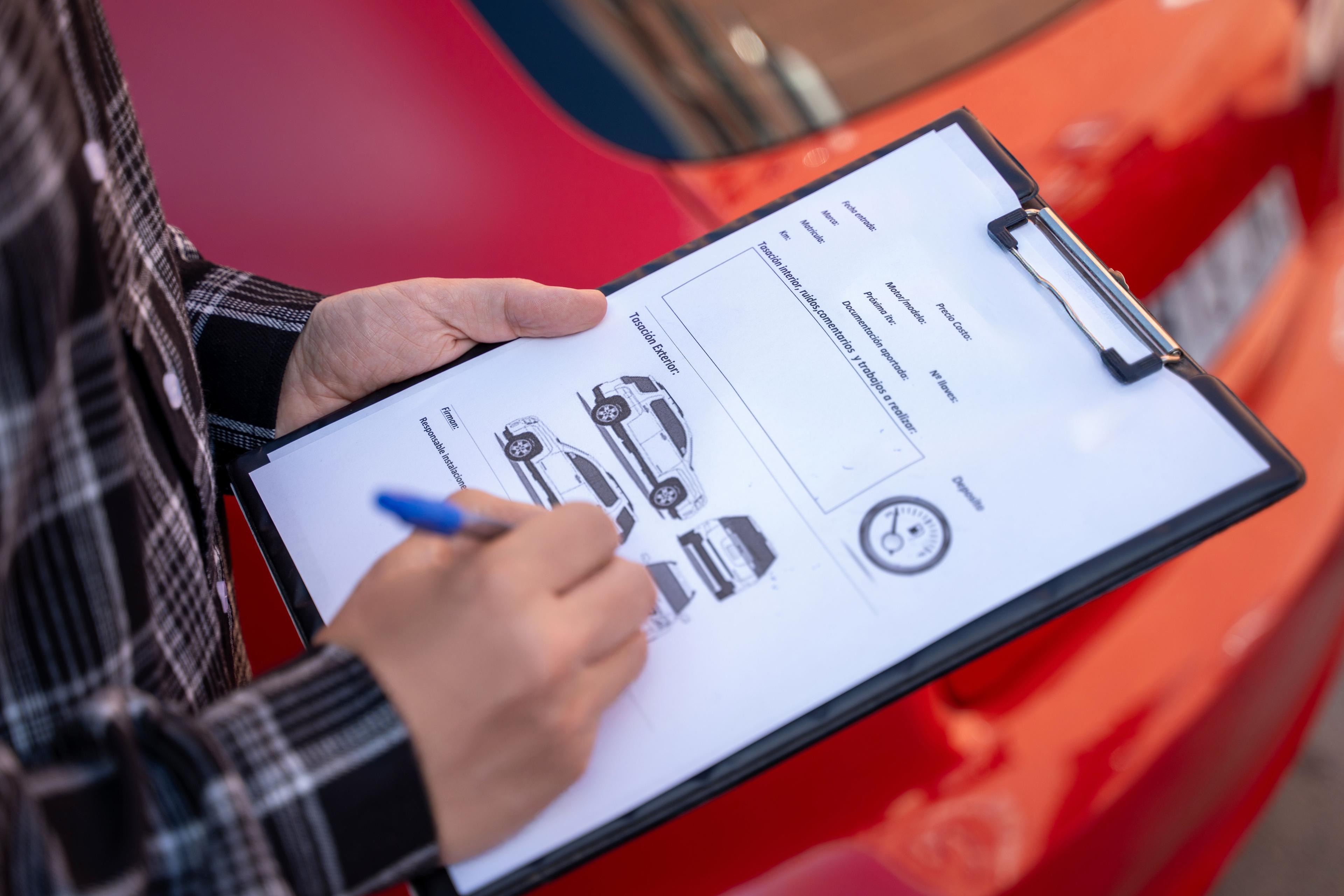
15. Get a Professional Pre-Purchase Hybrid Inspection
One of the most useful precautions is arranging an independent inspection before making the final purchase decision.
Choose an authorised service provider or a reputable workshop with experience in the specific hybrid model.
A comprehensive inspection should cover the hybrid battery, brake control system, engine, transmission, charging system, cooling systems, suspension, and general vehicle condition.
Ask for a written diagnostic report rather than relying only on a verbal confirmation that the vehicle is in good condition.
If the inspection identifies a potentially expensive fault, obtain an estimate of the repair cost and consider it alongside the vehicle's selling price.
Where possible, clarify whether previous battery or brake system repairs involved new, used, refurbished, or reconditioned components.
The quality of previous repairs and the availability of suitable warranty coverage can influence long-term ownership costs.
16. Used Hybrid Pre-Purchase Checklist
Before buying a used hybrid in Sri Lanka, make sure the following areas have been checked.
- Hybrid battery diagnostics: Inspect relevant battery fault codes, block voltage behaviour, internal resistance, and other manufacturer-supported battery health data.
- Battery cooling: Check air intake cleanliness, cooling fan operation, and battery temperature information.
- Dashboard warnings: Confirm that hybrid, ABS, brake, and stability control warning lights behave correctly.
- Brake actuator and booster: Check for abnormal pump cycling, hydraulic pressure faults, and relevant diagnostic codes.
- Brake pedal: Look for unusual pedal travel, stiffness, or inconsistent response.
- Diagnostic history: Check current and stored fault codes and any available evidence of recently cleared faults.
- Road test: Observe hybrid battery behaviour, engine operation, braking response, and abnormal noises during a controlled test drive.
- Service records: Review previous maintenance, hybrid battery repairs, brake work, coolant servicing, and transmission maintenance.
- Vehicle condition: Inspect for accident damage, flood exposure, electrical modifications, and other mechanical problems.
- Professional report: Obtain a written pre-purchase inspection report from a suitably qualified hybrid specialist.
MotorGuide's Advice: Don't Buy a Used Hybrid Based on Appearance Alone
At MotorGuide, our advice is to take your time when choosing a used hybrid vehicle.
Although a clean exterior, smooth test drive, and attractive selling price are important, they do not guarantee that the hybrid battery and brake control system are in good condition.
Before buying a Toyota Prius, Aqua, Axio Hybrid, Honda Vezel Hybrid, or another used hybrid, arrange a detailed diagnostic inspection.
Pay particular attention to battery voltage behaviour, cooling system condition, brake actuator operation, diagnostic trouble codes, and previous maintenance records.
Remember that individual battery health percentages, voltage differences, and pump noises should not be used as the only basis for diagnosing expensive faults.
Use the manufacturer's diagnostic procedures and the advice of an experienced hybrid technician.
If a vehicle has serious unresolved battery or braking problems, consider the potential repair costs carefully before proceeding with the purchase.
A thorough pre-purchase inspection cannot guarantee that a used hybrid will remain trouble-free for years, but it can help identify existing problems and reduce the risk of unexpected expenses.
Stay connected with MotorGuide for more useful information about hybrid vehicle maintenance, battery technology, braking systems, used car inspections, and practical automotive advice for Sri Lankan drivers.

எழுதியவர்
Nisaga Sandaru
A versatile and highly experienced professional, currently an Automobile undergraduate at the University of Jaffna, with strong technical expertise grounded in hands-on work as a technician with SriLankan Airlines Ground Support Equipment (GSE). Holding an Automobile NVQ Level 3 qualification, along with specialized certifications in Vehicle ECU Programming and Diagnosis, and extensive experience in arc welding and vehicle body painting, and well equipped to handle complex automotive, diagnostic, and fabrication-related tasks with a high level of competence.