What is the HVAC Unit in a Vehicle's A/C System?

Today at Motor Guide, we are discussing a specific system in automotive technology that many people only understand in a very simple way. That is, what exactly is a vehicle's HVAC unit and what does it do? The majority of people in our country generally use just the word "AC" to identify this entire system in a vehicle. But in the real technical world, the AC is only one part of this entire system. Therefore, today we will discuss these facts one by one, very clearly, simply, and in detail.
It is essential for everyone who uses a vehicle to have an accurate understanding of how this system operates.
What Does HVAC Stand For?
First, let's see what the abbreviation HVAC actually means. Here, the letter H stands for Heating, the letter V stands for Ventilation (controlling and cleaning the airflow), and the letters AC stand for Air Conditioning (cooling the air and removing moisture to make it dry). As people in this field, one thing we constantly see is that living in a tropical country like Sri Lanka, we often think we only ever need cooling. However, when manufacturing a vehicle, this system is designed to withstand any climate in the world. This entire system has to work together to heat the interior when driving in a cold region and to prevent the windows from fogging up during heavy rain.
Location and Structure
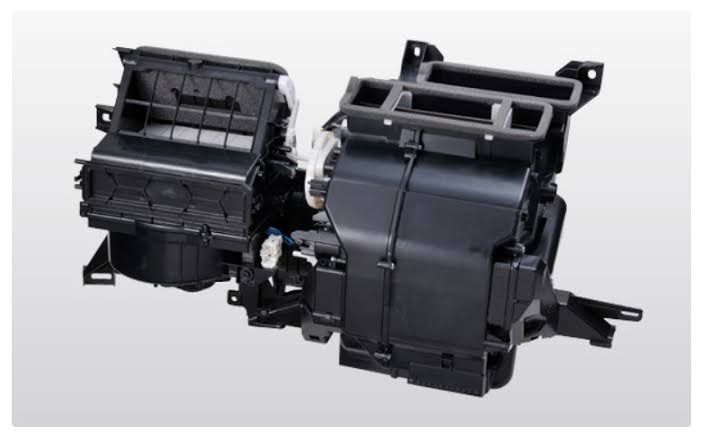
Now let's look at where this main component, the HVAC unit, is located in the vehicle. Usually, this is situated behind the vehicle's front dashboard, right in the middle between the passenger seat and the driver's seat. It takes the shape of a large plastic box. Inside this plastic box, there are several systematically arranged chambers. Almost all the main components that control the climate inside the vehicle are contained within this box. Therefore, it's not wrong to call it the vehicle's climate control center. This entire system operates with the help of the power from the engine and the vehicle's electrical system.
The Blower Motor
One of the main components inside this HVAC unit is the blower motor. It is through this motor that the air inside the vehicle or the air taken from outside is forcefully pulled into the system. Then, with the help of this motor, that air is conditioned to our desired temperature and sent into the cabin through the vehicle's air vents. A special resistor is used to control the speed of this motor. When this resistor fails, the blower only works at its maximum speed. Such issues are frequently seen in this system.
The Evaporator (Cooling Coil)
The next important part is the evaporator, or as our people usually call it, the cooling coil. When we turn on the vehicle's AC, the refrigerant gas sent by the compressor makes this cooling coil extremely cold. As the wind from the blower motor passes through this cooling coil, that air stream becomes cold. Also, the moisture in the air condenses on this coil and flows out of the vehicle as water. That is why water drips from underneath when a vehicle is parked. This is the process that helps remove moisture inside the vehicle during rain and keeps the windows clear. The expansion valve is also mounted right above this cooling coil.
The Heater Core
In addition to this, there is another part inside this unit that looks like a small radiator, called the heater core. As professionals in this field, a common mistake we see in Sri Lanka is that when a leak occurs in this heater core, some people cut and bypass the water pipes leading to it. However, it is the hot coolant from the heating engine that runs through this heater core. When we need to heat the inside of the vehicle, the air from the blower is directed through this heater core. This warm air is absolutely essential, especially in cold areas like Nuwara Eliya, and to clear fog during heavy rain. Therefore, cutting off the heater line can never be recommended.
Blend Doors and Mode Doors
Besides all these components, there is a very complex system of doors operating inside the HVAC unit. We call these blend doors and mode doors. These doors are controlled by small electric motors called actuators. When you change the temperature in the vehicle, this blend door mixes the cold air and hot air to the exact proportion to give you the specific temperature you need. Also, the mode doors determine whether the air should blow towards your face, your feet, or the windshield. When the plastic gear teeth in these actuators break, you will start hearing a "tick-tick" noise from inside the dashboard.
The Recirculation Door
Another important door is called the recirculation door. This determines whether fresh air from the outside is taken into the vehicle, or if the air already inside the vehicle is continuously recirculated. When driving on a highly dusty road, we should set this to only recirculate the inside air. Otherwise, harmful outside air and smoke will enter the vehicle and cause discomfort. In modern vehicles, all these doors are controlled by a computerized system.
Auto Climate Control
In the auto climate control systems found in modern vehicles, this process happens very intelligently. Temperature sensors inside and outside the vehicle feed data to the computer. Then, the computer operates the actuators I mentioned earlier to automatically control the opening and closing of the doors. Some vehicles have a dual-zone feature. This means the driver can set one temperature, and the passenger on the other side can set a different temperature. This is done by operating the blend doors inside this HVAC box separately.
The Cabin Air Filter
Another part that simply cannot be forgotten is the cabin air filter. This filter prevents outside dust, leaves, and debris from entering the HVAC unit. When this filter gets dirty, the amount of airflow coming into the vehicle decreases, and an unpleasant odor can also emanate from inside the vehicle. It also causes dust to build up on the surface of the cooling coil, leading to its decay and the growth of bacteria. Therefore, replacing this filter on time is very important.
The AC Drain Tube and Cowl Panel
Furthermore, there is a water drain tube at the bottom of this HVAC unit. The water produced by the cooling coil exits through this tube. Another issue is this water tube getting clogged. When that happens, the water doesn't go outside but flows onto the vehicle's carpet. If the carpet is wet underneath, it means this water tube is blocked. Therefore, having a good understanding of all these parts will undoubtedly be a great help when maintaining a vehicle.
Another thing is that the air intake location for this HVAC unit is situated below the vehicle's windshield, near the cowl panel where the wipers are mounted. Very often, when vehicles are parked under trees, leaves can fall into those vents. They go straight in and rest on top of the cabin filter or inside the HVAC box. Because of this, it is important to keep the vehicle's exterior cowl panel clean at all times. If not, the rotting leaves and debris inside the system can cause a severe bad odor, and it can also damage the blower motor.
Motor Guide's Final Advice
Our advice at Motor Guide is that this HVAC unit is a system that directly affects the comfort of the vehicle as well as the health of its occupants. Therefore, do not forget to replace the cabin filter at least once a year. Also, if a strange noise or bad smell comes from inside the vehicle, or if you feel the airflow has decreased, immediately get the HVAC unit and its actuators checked by a qualified technician. By properly maintaining the system without cutting and bypassing heater lines, you can preserve both the value and safety of your vehicle. Make sure to use only standard spare parts for this without resorting to temporary fixes.
And don't forget to always stay tuned with Motor Guide to learn more valuable information like this about modern vehicles and technology!

எழுதியவர்
Nisaga Sandaru
A versatile and highly experienced professional, currently an Automobile undergraduate at the University of Jaffna, with strong technical expertise grounded in hands-on work as a technician with SriLankan Airlines Ground Support Equipment (GSE). Holding an Automobile NVQ Level 3 qualification, along with specialized certifications in Vehicle ECU Programming and Diagnosis, and extensive experience in arc welding and vehicle body painting, and well equipped to handle complex automotive, diagnostic, and fabrication-related tasks with a high level of competence.