What Are Active Grille Shutters in a Vehicle and How Do They Work?


Today at MotorGuide, we're going to explore a clever automotive technology that can help improve fuel efficiency and manage engine temperature. It's a feature found in some modern vehicles, but one that most drivers rarely notice. We're talking about Active Grille Shutters.
Most of us are familiar with the grille at the front of a car. In many conventional vehicles, its openings allow outside air to flow towards the radiator and other cooling components while the vehicle is moving.
However, not every driving situation requires the same amount of cooling airflow. When more air enters the engine compartment than necessary, it can increase aerodynamic drag, particularly at higher speeds.
To address this, vehicle manufacturers have developed electronically controlled grille shutters that can open or close according to the vehicle's operating conditions.
So, how exactly do Active Grille Shutters work? What are their advantages, and what problems can develop over time? Let's take a closer look.
What Are Active Grille Shutters?
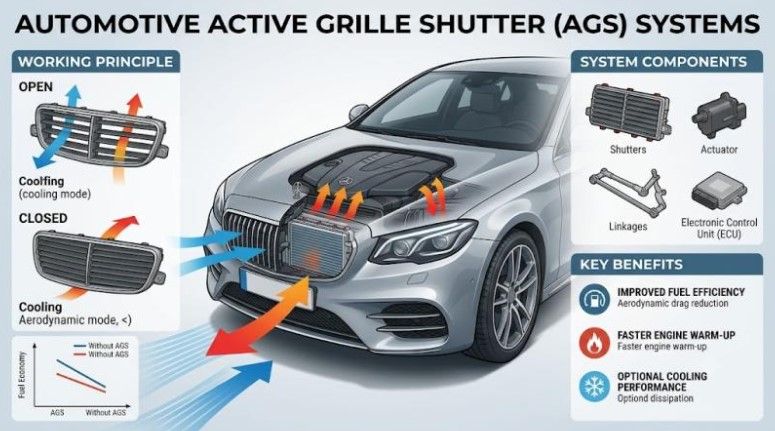
In simple terms, Active Grille Shutters are electronically controlled panels or louvres installed within the vehicle's front air intake area, often behind the grille and ahead of the radiator.
These panels can open and close automatically to regulate the amount of outside air flowing through the front of the vehicle.
You can think of them as operating somewhat like adjustable window blinds.
When additional cooling is required, the shutters open to allow more air through the radiator and other cooling components.
When less cooling is needed, the shutters may partially or fully close to reduce unnecessary airflow entering the engine compartment.
Manufacturers including Ford, BMW, and Toyota have used active grille shutter technology in selected vehicles. Similar active air-management systems can also be found in some electric vehicles.
The main objective is to balance cooling requirements with aerodynamic efficiency.
What Components Make the System Work?
An Active Grille Shutter system generally includes a set of movable shutters, an electric actuator, position-monitoring components, and an electronic control system.
The vehicle's computer may use information such as engine coolant temperature, vehicle speed, air conditioning demand, and other operating conditions to determine the appropriate shutter position.
The electric actuator moves the shutters according to instructions from the control system.
Depending on the vehicle, the shutters may remain fully open, fully closed, or partially open.
This allows airflow to be adjusted automatically without the driver needing to operate any additional controls.
1. Active Grille Shutters During a Cold Start
One situation where Active Grille Shutters can be useful is when starting the engine from cold.
After a vehicle has been parked for several hours, its engine and coolant may be at a relatively low temperature.
For efficient operation, a combustion engine generally needs to reach its intended operating temperature.
During the warm-up period, the engine management system may keep the grille shutters closed or partially closed when cooling demand is low.
This reduces airflow through the radiator area and can help the engine and other components warm up more quickly under suitable conditions.
Reaching the correct operating temperature can support more efficient engine operation and help reduce some warm-up-related fuel consumption and emissions.
However, the shutters do not necessarily close completely every time the engine is started. Their position depends on the vehicle's cooling requirements and control strategy.
2. Active Grille Shutters During Highway Driving
Another important benefit of Active Grille Shutters becomes noticeable during higher-speed driving.
When a vehicle travels along a highway, it must push through the surrounding air.
This creates aerodynamic drag, a force that opposes the vehicle's forward movement.
The faster a vehicle travels, the more important aerodynamic resistance becomes in determining its energy consumption.
If the engine and cooling system do not require substantial additional airflow, the vehicle's computer may close the grille shutters.
Closing the shutters helps prevent unnecessary air from entering the engine compartment, allowing airflow to move more efficiently around the vehicle's exterior.
This can reduce aerodynamic drag and the amount of energy required to maintain a given speed.
As a result, Active Grille Shutters may improve fuel economy in combustion-engine vehicles and help reduce electricity consumption in compatible electric vehicles.
Some automotive applications have reported fuel-efficiency improvements in the low single-digit percentage range, but a universal improvement of 2% to 5% should not be assumed.
The actual benefit depends on vehicle design, driving speed, cooling demand, ambient temperature, and other operating conditions.
3. Active Grille Shutters Under Heavy Loads
Active Grille Shutters also play an important role when a vehicle requires additional cooling.
For example, climbing a steep hill, carrying a heavy load, or operating in hot weather can increase the amount of heat produced by the engine and drivetrain.
In these conditions, the cooling system may require more airflow through the radiator.
The vehicle's control system can respond by opening the grille shutters to allow more air to pass through the cooling components.
This helps the radiator release heat and supports the vehicle's temperature-management system.
When the vehicle is stationary or moving slowly in traffic, the radiator fan can draw air through the available openings to support cooling.
However, the shutters do not automatically remain open in every traffic situation. The system adjusts their position according to the actual cooling demand.
Active Grille Shutters are also not a substitute for a properly functioning radiator, cooling fan, thermostat, coolant system, or other essential cooling components.
How Do Active Grille Shutters Improve Aerodynamics?
To understand their aerodynamic benefit, we need to look at what happens when air enters the front of a moving vehicle.
In a conventional grille arrangement, outside air flows into the engine compartment, where it passes through cooling components and around various internal structures.
This airflow can contribute to aerodynamic resistance.
When Active Grille Shutters close under suitable conditions, they restrict unnecessary airflow into this area.
This can improve the movement of air around the front of the vehicle and reduce some of the drag associated with the cooling system.
Reducing aerodynamic resistance can be particularly beneficial during steady highway cruising, when drag forms a significant part of the energy required to move the vehicle.
However, the effectiveness of the system depends on the complete aerodynamic design of the vehicle rather than the grille shutters alone.
Common Problems with Active Grille Shutters
Like other electronically controlled vehicle components, Active Grille Shutters can develop faults over time.
One common issue is the accumulation of dirt, leaves, mud, or small road debris around the shutter mechanism.
If debris becomes trapped between the moving panels, it may prevent them from opening or closing correctly.
Another possible problem is failure of the electric actuator or the mechanical components used to move the shutters.
Damaged wiring, electrical connectors, or position-monitoring components may also affect operation.
When a fault occurs, the shutters may become stuck in an open, closed, or partially open position.
What Happens If the Shutters Get Stuck?
The consequences depend on which position the shutters become stuck in.
If they remain open when additional cooling is unnecessary, the vehicle may experience slightly higher aerodynamic drag and reduced efficiency.
However, if the shutters become stuck closed while the engine requires substantial cooling, airflow through the radiator may be restricted.
Under demanding conditions, this can contribute to excessive engine temperature.
Some vehicles are designed to detect shutter system faults and respond by storing diagnostic trouble codes or displaying a warning light.
Depending on the vehicle and the severity of the problem, the system may also adopt a protective operating strategy.
However, not every shutter fault automatically activates the Check Engine Light or puts the vehicle into Limp Mode.
If you notice an engine temperature warning, stop driving when it is safe to do so and follow the manufacturer's recommended overheating procedures.
How to Maintain Active Grille Shutters
At MotorGuide, our advice is to include the front grille area in your regular vehicle inspections, especially after travelling through muddy or dusty roads.
Check whether leaves, dirt, or other debris have accumulated around the grille openings.
If the shutters are accessible, carefully inspect the area for visible damage or obstructions without forcing the mechanism.
During vehicle washing, avoid directing a concentrated high-pressure water jet into the shutter assembly or nearby electrical components.
If permitted by the manufacturer, loose surface dirt can be removed gently using appropriate cleaning methods.
Never attempt to force the shutters open or closed by hand.
The mechanism may contain delicate plastic components, gears, and an electric actuator that could be damaged by excessive force.
If the shutters are stuck, operating abnormally, or producing unusual noises, have the system inspected by a qualified technician.
A technician can check the actuator, electrical connections, control system, and stored diagnostic trouble codes to identify the cause of the problem.
Proper maintenance can help keep the shutter mechanism functioning as intended while supporting the vehicle's cooling performance and aerodynamic efficiency.
Although Active Grille Shutters may not be as noticeable as other modern vehicle technologies, they demonstrate how relatively small engineering improvements can help vehicles use energy more efficiently.
Stay connected with MotorGuide for more useful information about modern automotive technologies, vehicle maintenance, fuel-saving systems, and everything you need to know about the world of vehicles.

எழுதியவர்
Nisaga Sandaru
A versatile and highly experienced professional, currently an Automobile undergraduate at the University of Jaffna, with strong technical expertise grounded in hands-on work as a technician with SriLankan Airlines Ground Support Equipment (GSE). Holding an Automobile NVQ Level 3 qualification, along with specialized certifications in Vehicle ECU Programming and Diagnosis, and extensive experience in arc welding and vehicle body painting, and well equipped to handle complex automotive, diagnostic, and fabrication-related tasks with a high level of competence.