What Is a Head-Up Display (HUD) in a Vehicle and How Does It Work?

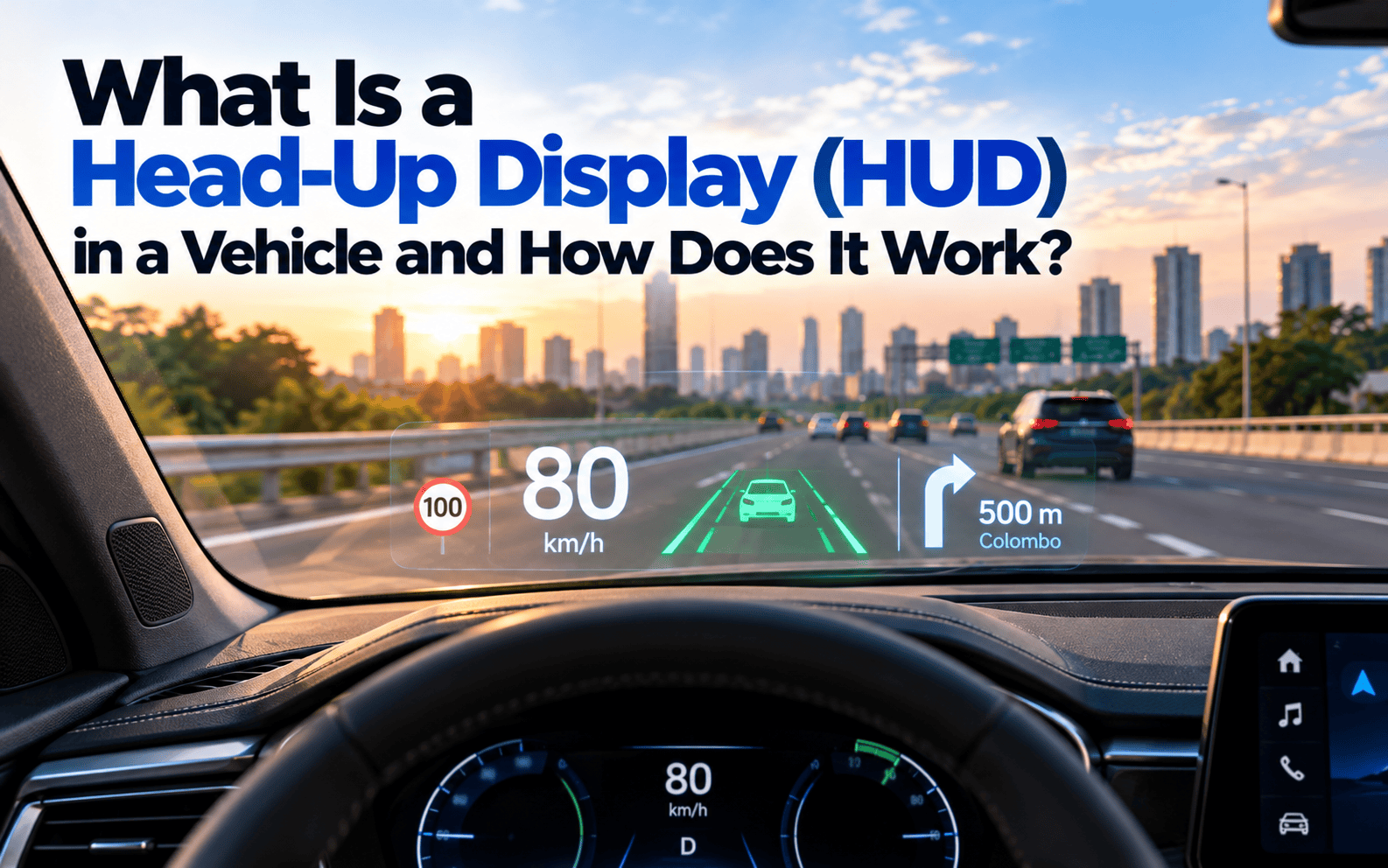
Today at MotorGuide, we're going to explore an advanced automotive feature that helps drivers access important information without constantly looking down at the dashboard. It's a technology with roots in aviation that has now become available in many modern passenger vehicles. We're talking about the Head-Up Display, commonly known as HUD.
When driving, keeping your attention on the road is extremely important. Whether you're navigating busy city traffic, travelling on a highway, or approaching an unfamiliar junction, you need to remain aware of the vehicles and obstacles around you.
However, checking your speed, navigation instructions, or instrument cluster often requires you to glance away from the road. Even a brief distraction can become dangerous in certain situations.
A Head-Up Display helps reduce the need to look down by presenting selected driving information within the driver's forward field of view.
So, how does this technology work? What are the different types of HUD systems, and how can they improve everyday driving? Let's take a closer look.
What Is a Head-Up Display?
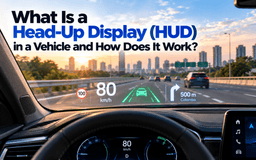
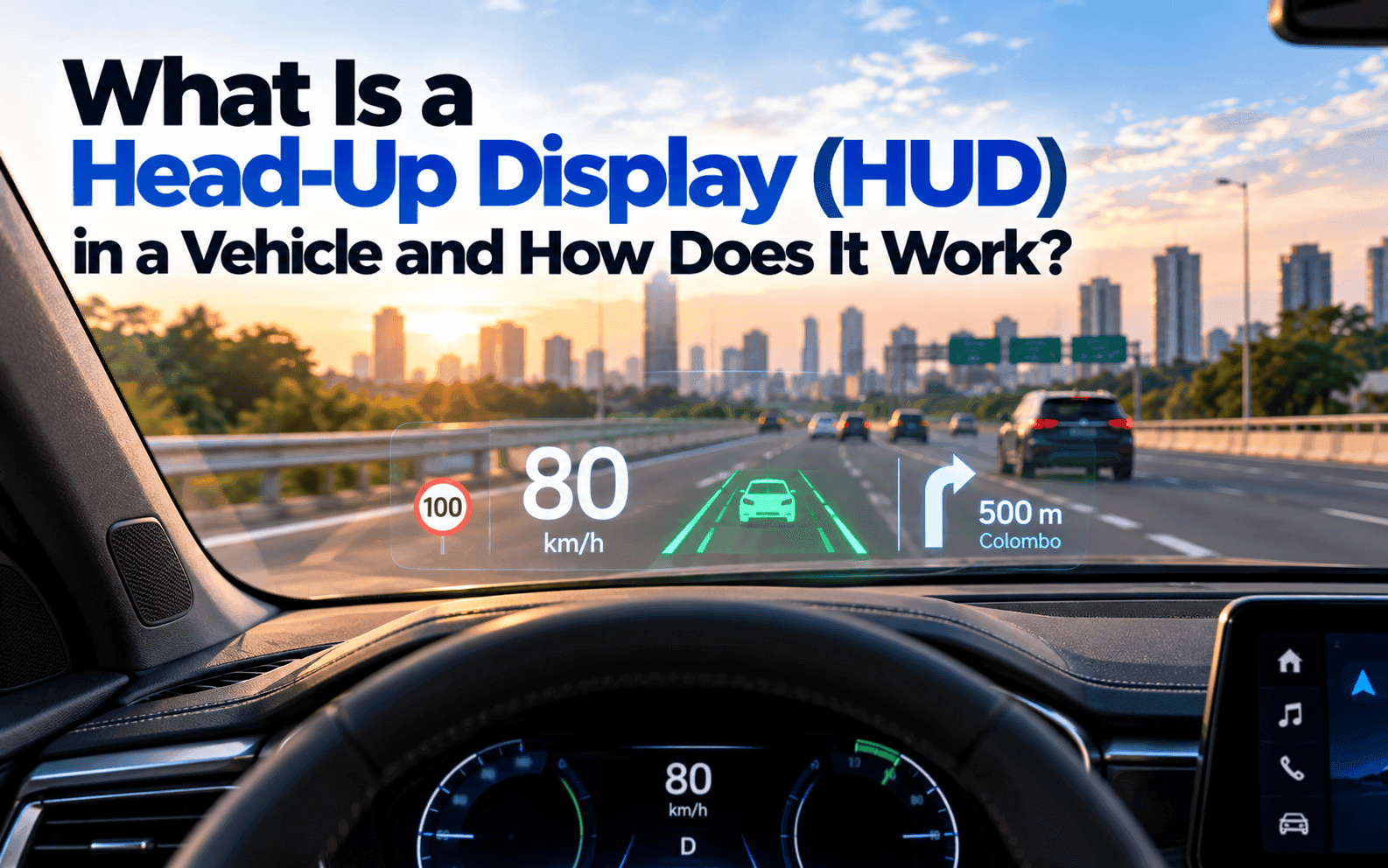
In simple terms, a Head-Up Display is an electronic system that presents important driving information in front of the driver, usually through an optical projection onto the windshield or a separate transparent display panel.
Depending on the vehicle, this information may include the current speed, navigation directions, speed limit information, cruise control settings, safety warnings, and other driving data.
The main purpose is to allow drivers to check selected information while keeping their heads in a more natural forward-facing position.
This is where the term Head-Up Display comes from.
Instead of repeatedly lowering your head to look at the instrument cluster, you can read the displayed information within your normal forward field of view.
Head-Up Display technology was originally developed for aviation applications and later adapted for passenger vehicles.
Today, manufacturers such as BMW, Mercedes-Benz, Toyota, and Mazda offer HUD technology on selected models and trim levels.
However, HUD is a driver assistance feature rather than a guarantee of safety. Drivers must still pay attention to road conditions, mirrors, traffic signals, and surrounding vehicles.
How Does a Head-Up Display Work?
A conventional automotive HUD uses an optical projection system, usually located inside the dashboard.
Depending on the design, this system may contain an LCD or another display source illuminated by LEDs, specially shaped mirrors, optical components, and an electronic control unit.
The HUD control system receives relevant information from the vehicle's electronic systems, such as the instrument cluster, navigation system, and driver assistance features.
It then generates an image containing the selected driving information.
The optical system directs this image towards the windshield or a dedicated transparent panel.
Through carefully designed reflection and projection, the driver sees a virtual image that appears to float at a distance in front of the vehicle.
Importantly, the information is not necessarily projected as a physical image onto the road itself. Instead, the optical system makes the image appear in the driver's forward view.
This arrangement helps drivers read information without looking as far away from the road as they would when checking a conventional dashboard display.
What Are the Different Types of Head-Up Displays?
Modern vehicles mainly use two common types of HUD systems: Combiner HUD and Windshield HUD.
Although both systems display driving information in front of the driver, their designs and optical arrangements are different.
1. Combiner Head-Up Display
A Combiner HUD uses a small transparent plastic or glass panel positioned above the dashboard.
In some vehicles, this panel automatically rises into position when the display is activated.
The projection system directs driving information towards the transparent panel, allowing the driver to see a virtual image within their forward field of view.
Combiner HUD systems can be relatively compact and may be less expensive to manufacture than more sophisticated windshield projection systems.
For this reason, they have been used in various mainstream and mid-range vehicles.
Although they provide useful driving information, the available display area and visual presentation may be more limited than those of advanced windshield HUD systems.
2. Windshield Head-Up Display
The second type is the Windshield Head-Up Display.
Instead of using a separate transparent screen, this system uses the vehicle's windshield as part of the optical arrangement.
The projection unit, which is usually located inside the dashboard, directs an image towards the windshield.
The driver then sees the information as a virtual image appearing ahead of the vehicle.
One important engineering challenge is preventing ghosting, where the displayed information appears as two overlapping or slightly separated images.
This happens because a conventional laminated windshield has multiple surfaces that can reflect light.
To reduce this problem, vehicles with windshield HUD systems often use specially designed laminated glass with a wedge-shaped interlayer.
The interlayer is commonly made using Polyvinyl Butyral (PVB), and its carefully controlled thickness helps align the reflected images.
This is one reason why windshield compatibility is particularly important in vehicles equipped with HUD technology.
What Is an Augmented Reality Head-Up Display?
One of the latest developments in automotive display technology is the Augmented Reality Head-Up Display, commonly known as AR-HUD.
Unlike conventional HUD systems that mainly display information such as speed and navigation symbols, AR-HUD systems can visually align certain graphics with objects or locations in the driver's forward view.
Depending on the vehicle, the system may use information from navigation software, cameras, sensors, and advanced driver assistance systems.
For example, when approaching a junction, an AR-HUD may display a virtual directional arrow that appears aligned with the road ahead.
This can make navigation instructions easier to understand, particularly when several roads or lanes are close together.
Some advanced systems may also display visual warnings related to the distance from vehicles ahead or other detected driving hazards.
For example, a warning symbol or highlighted area may appear when the vehicle detects a situation requiring the driver's attention.
However, the exact graphics, warning colours, and supported safety functions vary significantly between manufacturers and models.
AR-HUD technology does not replace the need for drivers to observe the road directly or respond appropriately to traffic conditions.
What Are the Advantages of a Head-Up Display?
One of the main advantages of HUD technology is that it can reduce the amount of time drivers spend looking down at the instrument cluster.
By displaying essential information closer to the driver's forward field of view, the system may help drivers monitor their speed and navigation instructions with smaller eye and head movements.
This can be particularly useful when travelling on highways, approaching unfamiliar junctions, or driving in areas where road conditions change frequently.
Another potential advantage is reduced visual refocusing.
When looking from the road to a nearby dashboard display, the eyes need to adjust their focus to a shorter viewing distance.
A HUD creates a virtual image that appears farther away than a conventional instrument panel, which can reduce the amount of refocusing needed when checking the displayed information.
However, the effect depends on the HUD's optical design, display distance, driver vision, and surrounding conditions.
A HUD does not completely eliminate eye strain or the need to refocus.
It may also help drivers access useful information at night, provided the display is adjusted to a suitable brightness level.
Nevertheless, overly bright graphics, unnecessary information, or poorly positioned displays can become distracting.
For this reason, HUD systems should present only relevant information in a clear and readable format.
Does a Head-Up Display Improve Driving Safety?
HUD technology is designed to support driver awareness by making selected information easier to access.
For example, checking vehicle speed through a properly positioned HUD may require less downward eye movement than looking at a traditional instrument cluster.
Navigation information displayed in the driver's forward view can also reduce the need to glance at the central infotainment screen.
However, simply keeping information within the forward field of view does not guarantee that the driver is paying attention to the road.
Drivers still need time to read and process the information, and some complex HUD graphics may create distractions of their own.
Therefore, the safety benefits depend on the display design, the driver's behaviour, and the driving situation.
HUD should be considered a useful driving aid rather than a system capable of preventing all accidents.
How to Adjust Your Vehicle's HUD Correctly
At MotorGuide, our advice is to adjust the Head-Up Display according to your normal driving position.
Most factory-installed HUD systems allow the driver to change settings such as display brightness, vertical position, and sometimes the amount of information shown.
Before driving, sit in your normal position and adjust the display until the information appears comfortably within your line of sight.
Make sure the display does not interfere with your view of the road or create unnecessary glare.
During night-time driving, reduce the brightness if the display appears too strong against the darker surroundings.
In bright sunlight, a higher brightness setting may be needed to keep the information readable.
Some modern vehicles can adjust HUD brightness automatically using ambient light sensors.
However, manual adjustments may still be useful depending on individual preferences and visibility conditions.
Why Is the Correct Windshield Important for HUD Vehicles?
Another important consideration is windshield replacement.
If your vehicle has a windshield-based HUD system and the glass becomes damaged, you should make sure that the replacement windshield is specifically compatible with the vehicle's HUD equipment.
Because the windshield forms part of the optical system, using unsuitable glass may cause the displayed information to appear distorted, blurred, or doubled.
HUD-compatible windshields may use specially engineered laminated glass and interlayer designs to ensure the projected image appears correctly.
For this reason, it is important to choose a replacement windshield that meets the vehicle manufacturer's specifications.
This may be an original equipment part or a properly approved equivalent that supports the vehicle's HUD system.
If the vehicle also contains cameras or sensors mounted near the windshield, the replacement procedure may require additional checks or calibration according to the manufacturer's instructions.
Using a qualified automotive glass specialist can help ensure the new windshield is installed correctly and the HUD continues to operate as intended.
With proper adjustment, maintenance, and responsible use, a Head-Up Display can make essential driving information more convenient to access while supporting a comfortable driving experience.
Stay connected with MotorGuide for more useful information about modern automotive technologies, vehicle safety systems, advanced driver assistance features, and everything you need to know about the world of vehicles.

எழுதியவர்
Nisaga Sandaru
A versatile and highly experienced professional, currently an Automobile undergraduate at the University of Jaffna, with strong technical expertise grounded in hands-on work as a technician with SriLankan Airlines Ground Support Equipment (GSE). Holding an Automobile NVQ Level 3 qualification, along with specialized certifications in Vehicle ECU Programming and Diagnosis, and extensive experience in arc welding and vehicle body painting, and well equipped to handle complex automotive, diagnostic, and fabrication-related tasks with a high level of competence.