What Is Crawl Control in a Vehicle and How Does It Work?

Today at MotorGuide, we're going to explore an advanced automotive technology that makes driving on challenging off-road terrain easier and more manageable. Whether you're travelling through muddy tracks, sandy hills, rocky trails, or uneven forest roads, controlling your vehicle can become difficult, especially when traction is limited.
One feature designed to assist drivers in these situations is Crawl Control, commonly available on selected Toyota Land Cruiser and Prado models.
Imagine your vehicle getting stuck in a muddy section or struggling to climb a sandy slope. In these situations, many drivers instinctively press the accelerator harder, hoping to push the vehicle forward. However, excessive acceleration can cause the wheels to spin without gaining enough traction, potentially making the situation worse.
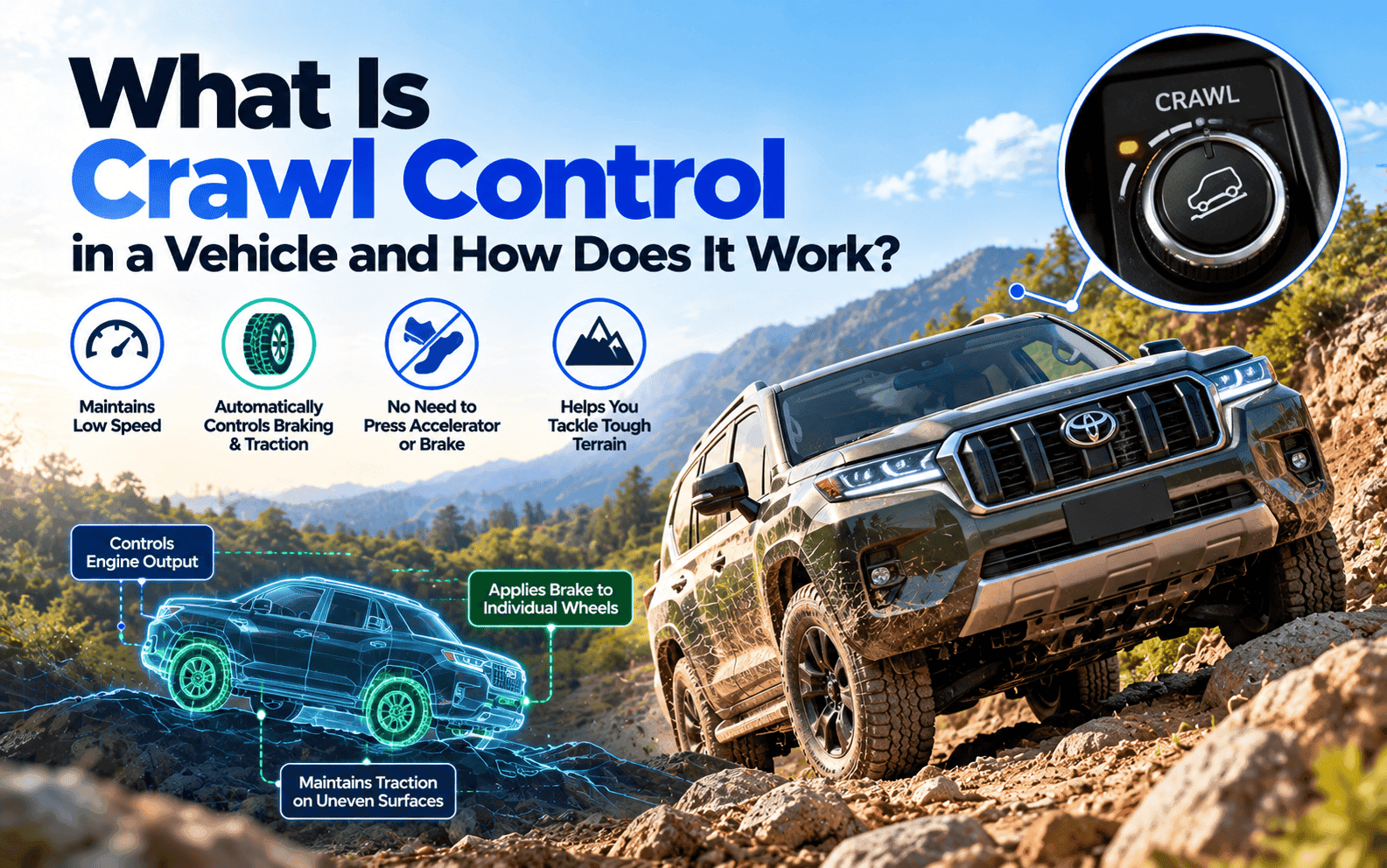
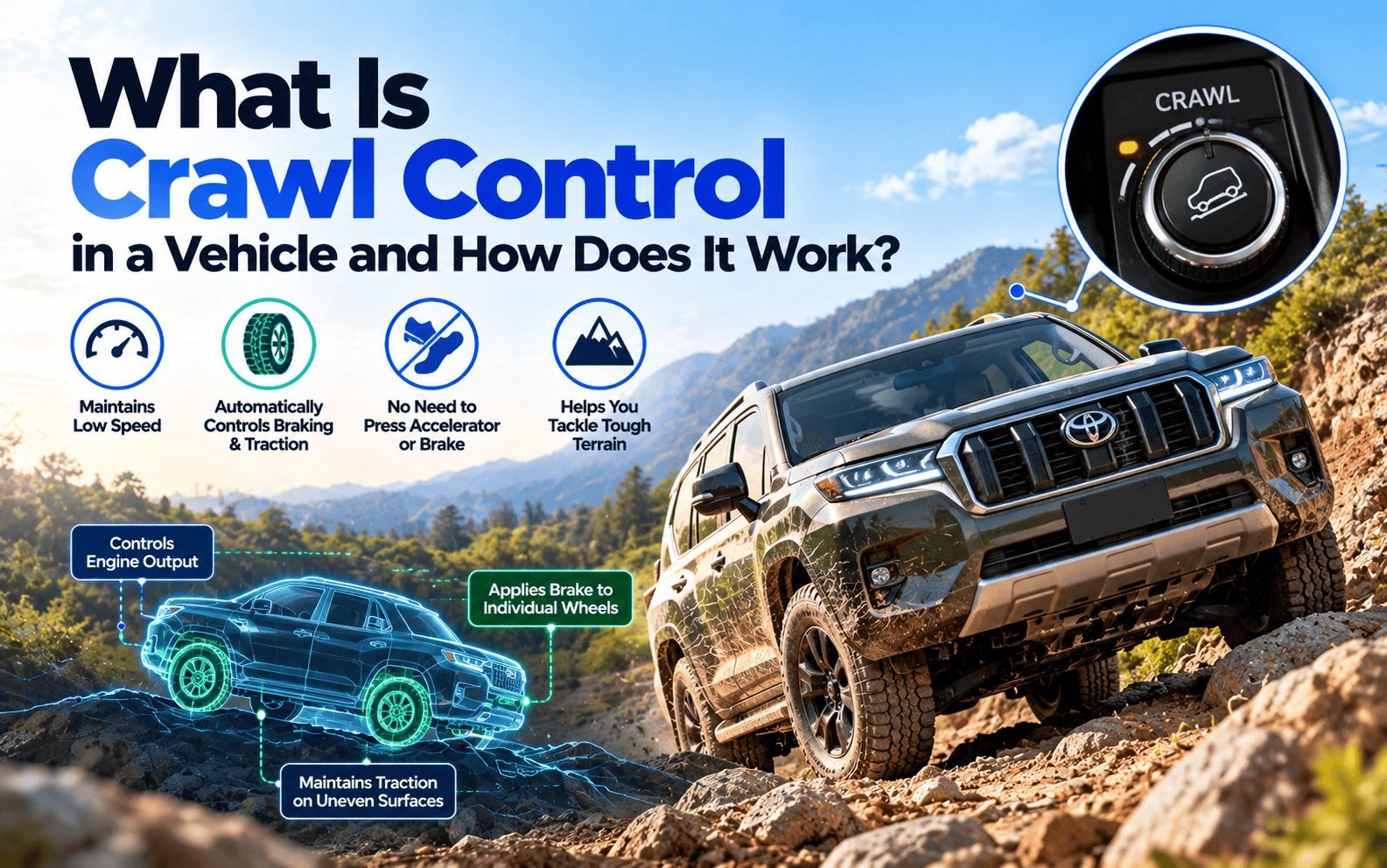
Crawl Control helps drivers manage difficult terrain by automatically controlling the vehicle's engine power and braking at very low speeds.
So, what exactly is Crawl Control, how does it work, and what are its main advantages? Let's take a closer look.
What Is Crawl Control?
In simple terms, Crawl Control is an advanced off-road driving assistance system that automatically manages acceleration and braking to help maintain a selected low vehicle speed.
It is often described as an off-road version of cruise control.
Unlike conventional cruise control, which is primarily designed for normal road driving, Crawl Control is developed for challenging surfaces such as rocks, mud, loose sand, and steep slopes.
When the system is active, the driver generally does not need to continuously operate the accelerator or brake pedal. Instead, the system automatically adjusts engine output and braking while the driver concentrates on steering and choosing a safe route.
This makes difficult off-road manoeuvres easier to manage, particularly when precise throttle control is required.
However, Crawl Control is not an autonomous driving system. The driver must remain alert and ready to intervene whenever necessary.
How Does Crawl Control Work?
Crawl Control works by combining several electronic vehicle systems.
These typically include wheel speed sensors, the Engine Control Unit (ECU), the Anti-lock Braking System (ABS), and electronic traction and stability control functions.
When the driver activates Crawl Control, the system continuously monitors the speed of the wheels and adjusts engine output and braking force according to driving conditions.
Depending on the Toyota model and generation, drivers can select from several low-speed settings using a dedicated control switch.
Some earlier Crawl Control systems operated at approximately 1 to 5 km/h, while newer systems offer different selectable speed settings.
Once a suitable setting is selected, Crawl Control automatically regulates the vehicle's movement to help maintain a slow and controlled speed.
This reduces the need to repeatedly press and release the accelerator and brake pedals while negotiating difficult terrain.
How Does Crawl Control Improve Traction?
One of the most useful features of Crawl Control is its ability to help control excessive wheel spin.
When driving over sand, mud, or rocky terrain, different wheels may experience different levels of traction.
For example, one wheel may be resting on loose sand while another has better contact with a firmer surface.
If too much engine power is applied, the wheel with less grip may spin excessively without moving the vehicle forward.
Crawl Control helps manage this situation by carefully regulating engine output and applying braking force when necessary.
Working alongside the vehicle's traction control system, it may apply braking pressure to individual wheels to help reduce unwanted wheel spin.
This allows the vehicle to move slowly and steadily across challenging surfaces, provided sufficient traction is available.
For example, when climbing a sandy slope, Crawl Control can help prevent sudden throttle inputs that might cause the wheels to dig into the sand.
Instead, the system attempts to maintain controlled wheel movement while the driver steers the vehicle along a suitable path.
However, Crawl Control cannot guarantee that a vehicle will escape from deep mud or sand. If there is insufficient tyre grip or the vehicle is severely stuck, additional recovery assistance may still be required.
Drivers may also notice clicking, buzzing, or hydraulic noises while Crawl Control is operating. These sounds can be normal because the braking system is repeatedly adjusting pressure to control the vehicle's movement.
How Does Crawl Control Help on Steep Slopes?
Crawl Control can also be useful when driving uphill or downhill on difficult off-road routes.
When climbing a steep slope, controlling the accelerator is important because sudden increases in engine power may lead to wheel spin and loss of traction.
By maintaining a low speed and controlling engine output, Crawl Control helps drivers approach steep terrain more smoothly.
It is also useful when descending steep slopes.
Instead of relying entirely on the driver to repeatedly apply the brakes, the system automatically manages braking to help maintain the selected crawling speed.
This allows the driver to focus more attention on steering around rocks, deep ruts, and other obstacles.
However, the system's effectiveness depends on the surface conditions, available tyre traction, vehicle configuration, and slope angle.
Crawl Control does not guarantee that the vehicle will never slide or lose control, especially on extremely slippery or unstable surfaces.
What Are the Advantages of Crawl Control?
One of the main advantages of Crawl Control is that it reduces the amount of accelerator and brake control required from the driver during demanding off-road driving.
In challenging situations, drivers often need to make very small and precise adjustments to vehicle speed.
Crawl Control helps perform these adjustments automatically, allowing the driver to pay more attention to steering and choosing the safest available route.
This can be particularly beneficial for drivers who have limited experience with advanced off-road manoeuvres.
Another advantage is smoother vehicle movement across uneven terrain.
By reducing excessive acceleration and sudden wheel spin, the system can help minimise unnecessary jerking and improve vehicle control.
This may also reduce some of the additional stress placed on components such as the chassis, suspension, tyres, and drivetrain during difficult off-road driving.
However, the system cannot eliminate all mechanical stress or prevent damage in every situation.
Proper driving technique, suitable tyres, sufficient ground clearance, and careful assessment of the terrain are still essential.
How to Activate Crawl Control
On many Toyota Land Cruiser and Prado models equipped with Crawl Control, the system requires the transfer case to be placed in the low-range four-wheel-drive setting, commonly known as 4L or L4.
This low-range setting provides greater torque multiplication and allows the vehicle to travel at controlled speeds over demanding terrain.
Depending on the model, the driver may need to select the correct transmission position and activate Crawl Control using the dedicated switch.
The desired low-speed setting can then be selected through the available controls.
However, activation procedures and operating requirements differ between vehicle models and generations.
Drivers should always follow the manufacturer's instructions rather than assuming every Crawl Control system operates in exactly the same way.
Important Safety Tips When Using Crawl Control
At MotorGuide, our advice is to use Crawl Control only in suitable off-road conditions and according to the vehicle manufacturer's recommendations.
If your vehicle requires 4L operation, make sure the transfer case is correctly engaged in low range before attempting to activate the system.
Another important consideration is brake temperature.
Because Crawl Control repeatedly uses the braking system to regulate vehicle speed and wheel movement, extended operation under demanding conditions may cause the brakes to become hot.
Some vehicles may temporarily limit or deactivate Crawl Control if the braking system becomes excessively hot.
If a warning appears, follow the instructions in the owner's manual and allow the system to cool when necessary.
Once the vehicle has safely passed the difficult section, switch off Crawl Control when it is no longer required.
Most importantly, remember that Crawl Control is a driving assistance system, not a replacement for driver judgement.
If the vehicle becomes severely stuck or the terrain exceeds its capabilities, suitable recovery equipment and assistance from experienced off-road drivers may still be necessary.
With proper use, Crawl Control can make challenging off-road driving more controlled, comfortable, and manageable.
Stay connected with MotorGuide for more useful information about modern automotive technologies, off-road driving systems, vehicle safety features, and everything you need to know about the world of vehicles.

எழுதியவர்
Nisaga Sandaru
A versatile and highly experienced professional, currently an Automobile undergraduate at the University of Jaffna, with strong technical expertise grounded in hands-on work as a technician with SriLankan Airlines Ground Support Equipment (GSE). Holding an Automobile NVQ Level 3 qualification, along with specialized certifications in Vehicle ECU Programming and Diagnosis, and extensive experience in arc welding and vehicle body painting, and well equipped to handle complex automotive, diagnostic, and fabrication-related tasks with a high level of competence.