What are Seat Belt Pre-tensioners?

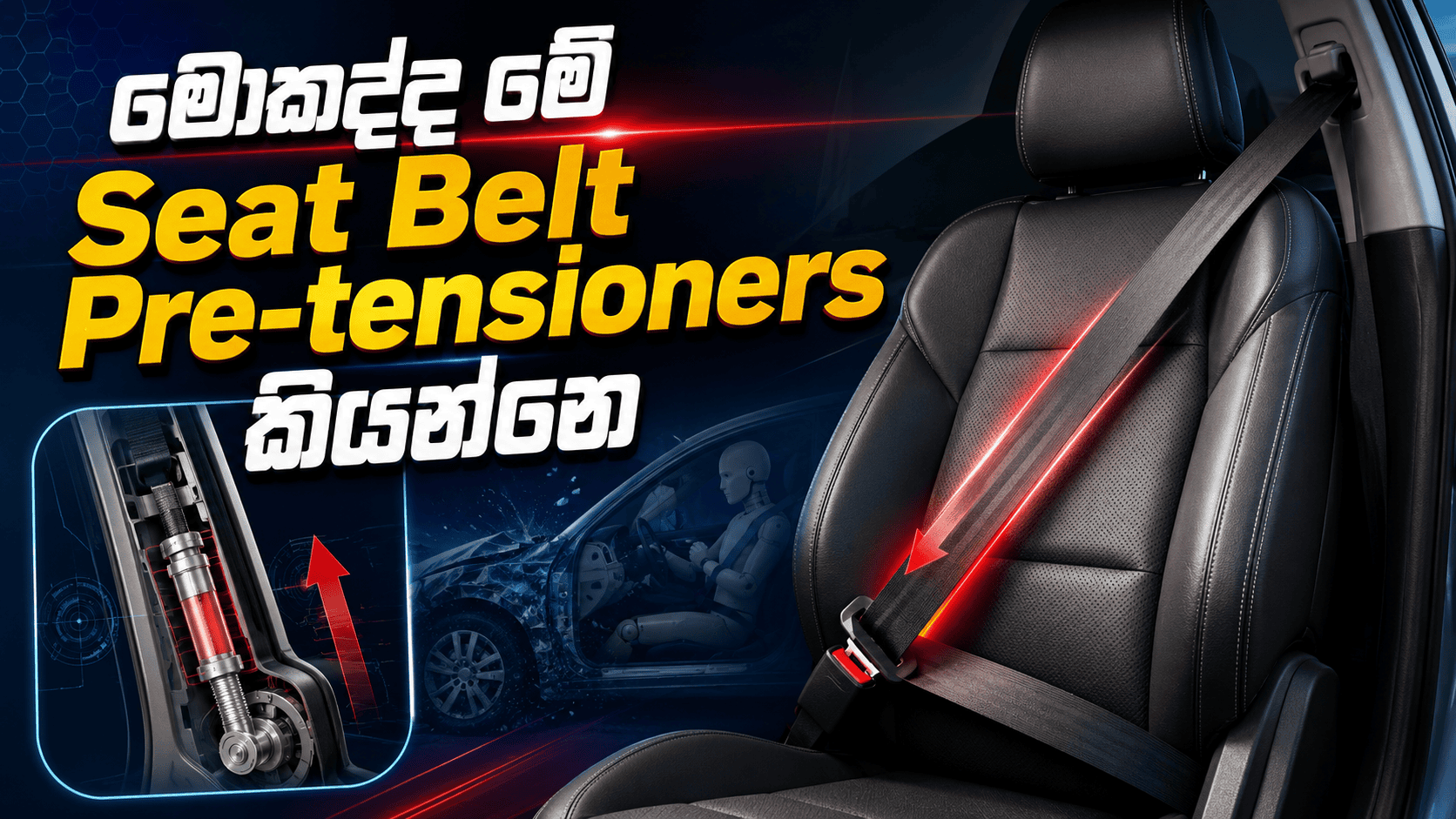
Today at Motor Guide, we are going to talk about an extremely important technological feature used to bring modern vehicle safety to its maximum level: the Seat Belt Pre-tensioner system. We will clearly discuss just how much this system does to save our lives during a vehicle crash compared to a standard seat belt.
As professionals in this field, something we frequently see is that many people think a seat belt is just a strap that you pull over your body and buckle up when you sit in a car. However, there is actually a much more complex technology operating behind it. A vehicle crash happens in a fraction of a millisecond. In such a situation, a normal seat belt might have a slight looseness or "slack." Due to this slack, controlling the forward thrust of the passenger's body can be slightly delayed. The Pre-tensioner system operates to minimize that delay and firmly pin the passenger's body against the seat at the exact moment of an impact.
The Technical Operation
Let's dive a bit deeper into the technical operation of this system. Collision Sensors mounted on the front or sides of the vehicle instantly detect when the vehicle is in a crash or undergoing hard braking. The electrical signal from these sensors is immediately sent to the vehicle's Safety Control Unit (SRS Airbag Control Unit). Through this unit, an electrical current is sent to the pre-tensioner mechanism, instantly igniting a small explosive membrane or chemical initiator (Gas Generator/Pyrotechnic Charge) inside it.
Along with this ignition, the resulting extreme gas pressure or mechanical force rapidly pulls the Seat Belt Reel/Retractor in the opposite direction, retracting any slack in the belt within milliseconds. This means that even before the passenger's body begins to lean forward during a crash, this system tightly grips the seat belt against the passenger's chest and shoulder. Because of this instantaneous process, the passenger is protected from violently hitting the steering wheel, dashboard, or the deploying airbag.
Types of Pre-tensioner Systems
Now let's look at the different types of pre-tensioner systems. Primarily, these can be divided into mechanical and electrical methods.
- Mechanical Systems: Older vehicles mostly used spring-loaded or mechanically operated methods.
- Pyrotechnic Pre-tensioners: In almost all modern vehicles, the pyrotechnic method is used. Because this method uses an explosive charge, if it fires once during an accident, the entire unit must be replaced with a brand-new one.
- Reversible Pre-tensioners: Some high-tech vehicles feature motor-driven Reversible Pre-tensioner systems. The special feature of this reversible method is that if it activates during an emergency (like hard braking) but an actual crash does not occur, the system can release the tension and return the seat belt to its normal state once the situation normalizes.
Crucial Safety and Maintenance Advice
As professionals in this industry, an important piece of advice we give you is: if a fault in these systems is indicated by the SRS/Airbag Warning Light on the vehicle's dashboard, never ignore it! Many people assume that light is only related to the airbags. But remember, the airbag system and the seat belt pre-tensioner system are interconnected and controlled by the same SRS ECU. If the pre-tensioner is not working, it is very difficult to provide full protection to the passenger using only the airbag during a crash.
Therefore, never attempt to perform DIY repairs on this system without proper tools and knowledge. Especially if you inspect these components without disconnecting the battery, an unexpected deployment of the pre-tensioner system can cause severe injuries.
Motor Guide's Final Advice
When driving a motor vehicle, giving priority to our lives and the lives of our passengers is our absolute responsibility. The seat belt pre-tensioner technology we discussed today is an extremely powerful safety measure that works silently behind the scenes to save our lives. Having an understanding of this will be very useful when you drive and maintain a vehicle in the future.
Motor Guide's final advice is that whenever your vehicle shows any fault or warning indicator regarding its safety systems (SRS/Airbags/Pre-tensioners), do not delay. Take it to a qualified technician, have it inspected using a Computer Diagnostic Scan, and get it fixed immediately. Never dangerously ignore these warnings.
And don't forget to always stay tuned with Motor Guide to learn more valuable information like this about modern vehicles and technology!

எழுதியவர்
Nisaga Sandaru
A versatile and highly experienced professional, currently an Automobile undergraduate at the University of Jaffna, with strong technical expertise grounded in hands-on work as a technician with SriLankan Airlines Ground Support Equipment (GSE). Holding an Automobile NVQ Level 3 qualification, along with specialized certifications in Vehicle ECU Programming and Diagnosis, and extensive experience in arc welding and vehicle body painting, and well equipped to handle complex automotive, diagnostic, and fabrication-related tasks with a high level of competence.