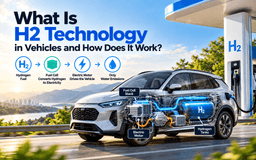
What Is H2 Technology in Vehicles and How Does It Work?

Today at MotorGuide, we're going to explore an automotive technology that could play an important role in the future of transportation. As countries around the world look for ways to reduce carbon emissions and environmental pollution, vehicle manufacturers are investing in alternative energy sources. One of the most interesting developments in this area is hydrogen technology, also known as H2 technology.
We all know that electric vehicles are becoming increasingly popular. However, charging times, battery production, and access to charging infrastructure are still important considerations for many drivers.
Hydrogen-powered vehicles offer a different approach to electric mobility. Instead of relying entirely on electricity stored in a large battery, certain hydrogen vehicles generate their own electricity using hydrogen gas.
But how exactly does this technology work? What are its advantages and disadvantages, and could it change the future of driving? Let's take a closer look.
What Is Hydrogen Vehicle Technology?
In simple terms, one of the main applications of hydrogen technology in vehicles is the Fuel Cell Electric Vehicle, commonly known as an FCEV.
Many people assume that hydrogen vehicles work by burning hydrogen inside an engine, just like petrol or diesel vehicles. Although hydrogen combustion engines do exist, fuel cell electric vehicles operate differently.
In an FCEV, the wheels are driven by an electric motor. The electricity required to operate that motor is generated onboard through a chemical reaction involving hydrogen and oxygen.
This means the vehicle doesn't rely on a large rechargeable battery as its primary energy source in the same way as a conventional Battery Electric Vehicle (BEV).
Instead, it uses a fuel cell system that acts like a small onboard electricity-generating unit.
Vehicles such as the Toyota Mirai and Hyundai Nexo demonstrate how hydrogen fuel cell technology can be applied to passenger vehicles.
These vehicles combine electric motor performance with the ability to refill hydrogen tanks at suitable refuelling stations, offering an alternative approach to zero-tailpipe-carbon-emission driving.
How Does Hydrogen Fuel Cell Technology Work?
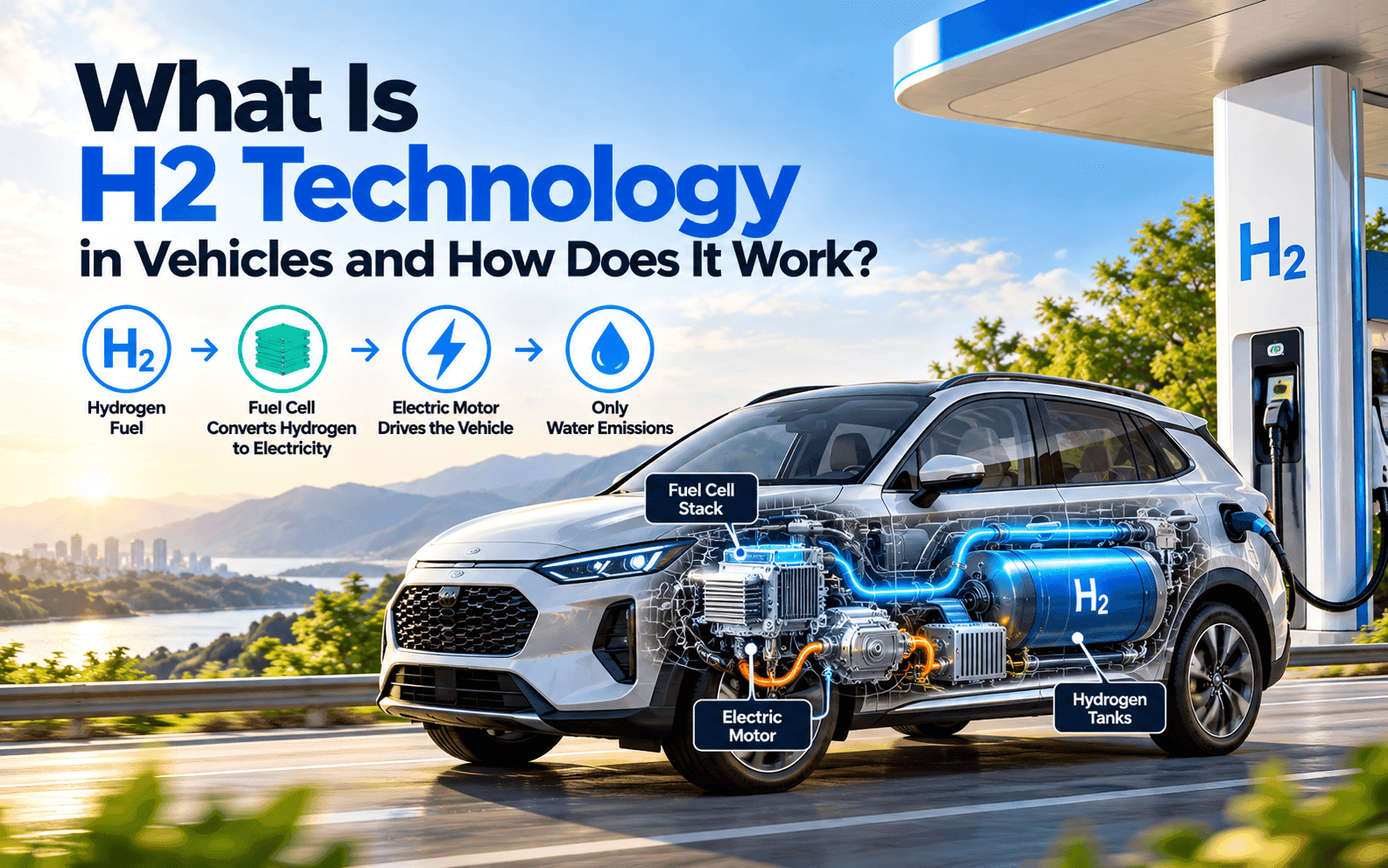
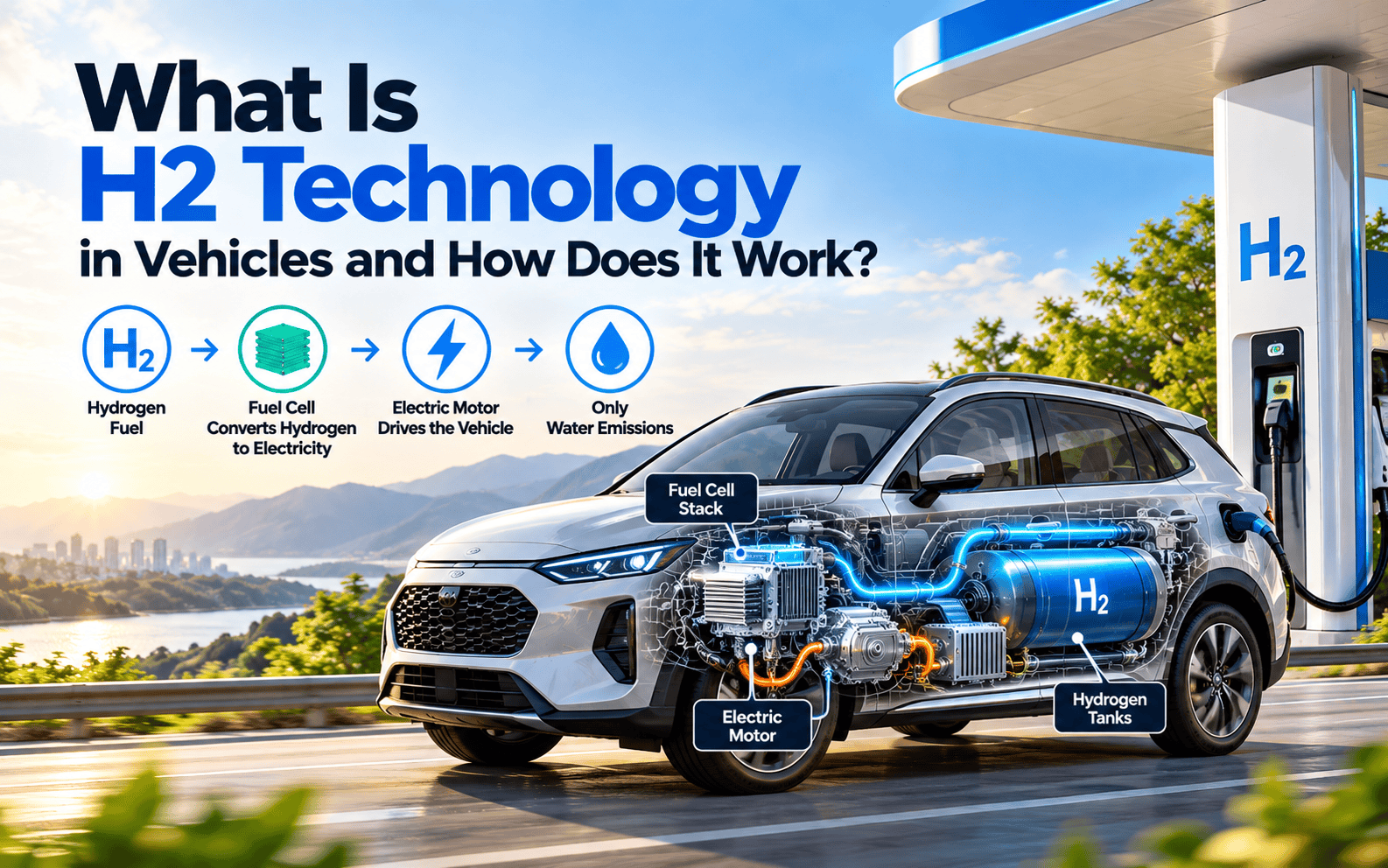
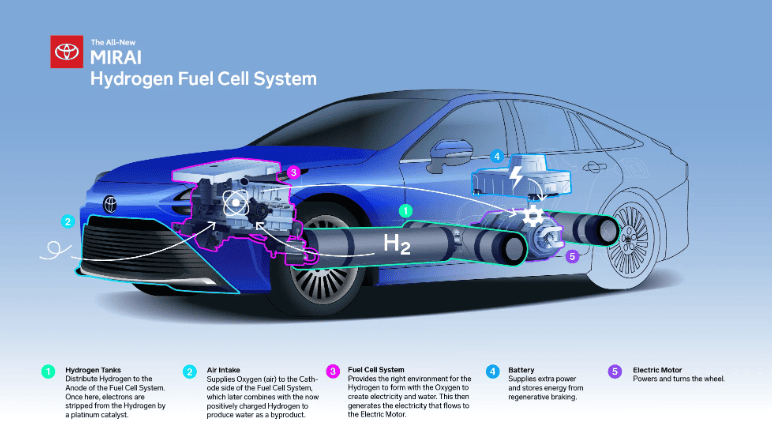
A typical hydrogen fuel cell vehicle contains several important components working together.
These include high-pressure hydrogen storage tanks, a fuel cell stack, a power control unit, a rechargeable battery, and an electric traction motor.
One of the most important components is the hydrogen storage system.
In many modern passenger FCEVs, hydrogen gas is stored inside specially designed, carbon-fibre-reinforced tanks at pressures of approximately 700 bar.
These tanks are engineered to withstand demanding operating conditions and include safety features designed to help prevent hydrogen leakage.
When the vehicle is switched on and the driver presses the accelerator, the fuel cell system begins generating electricity through an electrochemical process.
Let's understand how this happens.
Step 1: Hydrogen Enters the Fuel Cell
First, hydrogen gas stored in the high-pressure tanks is supplied to the fuel cell system through pressure-regulating components.
At the same time, air from outside the vehicle enters through the air intake system.
This incoming air contains oxygen, which is essential for the fuel cell's electricity-generating process.
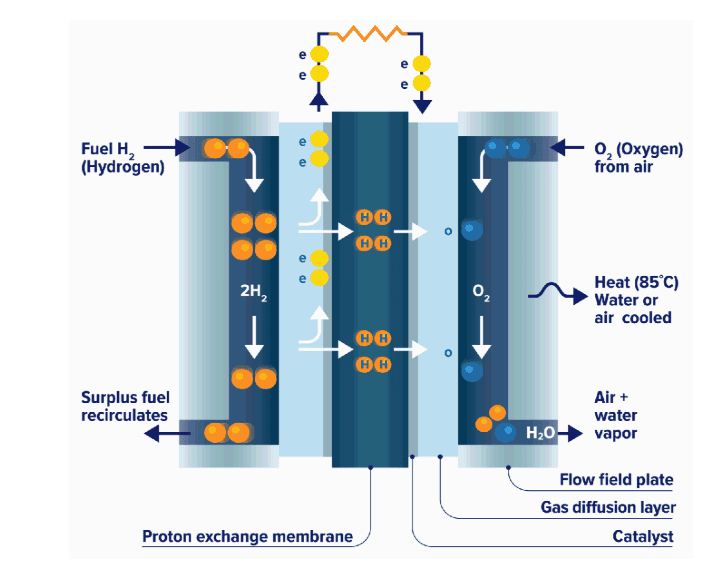
Inside the fuel cell stack, hydrogen and oxygen take part in a controlled electrochemical reaction.
Unlike a conventional combustion engine, this process does not involve burning the hydrogen to generate mechanical power.
Step 2: Electricity Is Generated
Inside the fuel cell stack, a special catalyst, often containing platinum, helps separate hydrogen molecules into positively charged hydrogen ions and electrons.
The hydrogen ions pass through a special membrane, while the electrons travel through an external electrical circuit.
This movement of electrons creates an electric current.
On the other side of the membrane, the hydrogen ions, electrons, and oxygen combine to form water.
Through this process, chemical energy stored in hydrogen is converted into electrical energy.
The electricity generated by the fuel cell is then managed by the vehicle's electronic power control system.
Step 3: Electricity Powers the Vehicle
The electricity produced by the fuel cell is supplied to the electric traction motor through the vehicle's power electronics.
The electric motor then drives the wheels, allowing the vehicle to move smoothly and quietly.
Most fuel cell electric vehicles also include a rechargeable battery that stores energy and assists the fuel cell during certain driving conditions.
For example, the battery can provide additional electrical power during acceleration and store energy recovered through regenerative braking.
Because the wheels are driven by an electric motor, the driving experience is similar in several ways to that of a battery electric vehicle.
Drivers can enjoy smooth acceleration, responsive torque delivery, and relatively quiet operation.
What Comes Out of a Hydrogen Vehicle's Exhaust?
One of the most interesting features of hydrogen fuel cell vehicles is their tailpipe emissions.
In a conventional petrol or diesel vehicle, burning fuel produces carbon dioxide and other exhaust pollutants.
However, a hydrogen fuel cell vehicle generates electricity through an electrochemical reaction rather than conventional fuel combustion.
The main reaction products are water and heat.
As a result, a fuel cell electric vehicle does not produce carbon dioxide emissions from its fuel cell exhaust during normal operation.
Water may be released from the vehicle in the form of vapour or liquid droplets.
This is why hydrogen fuel cell vehicles are commonly classified as zero-tailpipe-emission vehicles.
However, the water released by a vehicle should not be assumed to be safe for drinking.
It's also important to understand that zero tailpipe emissions do not necessarily mean zero environmental impact.
The overall carbon footprint of a hydrogen vehicle depends heavily on how the hydrogen is produced, processed, transported, and supplied to the vehicle.
What Are the Advantages of Hydrogen Vehicles?
Hydrogen fuel cell technology offers several potential benefits, especially for certain transport applications.
One of the biggest advantages is relatively fast refuelling.
While battery electric vehicles may require anywhere from several minutes to several hours to recharge, depending on their battery capacity and charging equipment, hydrogen vehicles can often be refuelled in a shorter period.
For example, under suitable conditions, some hydrogen passenger vehicles can complete refuelling in approximately 3 to 5 minutes.
This is similar to the time required to refill a conventional petrol or diesel vehicle.
However, actual refuelling times depend on station availability, hydrogen pressure, temperature, and refuelling equipment.
Long Driving Range
Another important advantage of hydrogen fuel cell vehicles is their potential driving range.
Certain hydrogen passenger vehicles can travel several hundred kilometres on a full tank.
Depending on the vehicle and the testing standard used, some models offer claimed driving ranges of approximately 600 to 800 kilometres.
However, actual driving range depends on vehicle specifications, driving speed, road conditions, weather, and driving style.
For drivers who regularly travel long distances, the combination of a substantial driving range and relatively quick refuelling can be attractive.
Potential Benefits for Heavy-Duty Vehicles
Hydrogen technology is also being explored for heavy-duty transportation, including buses, trucks, and commercial fleets.
One possible advantage is that hydrogen storage and fuel cell systems may offer useful weight and refuelling characteristics for certain long-distance or high-utilisation applications.
Unlike battery electric vehicles that depend on storing large amounts of electricity onboard, fuel cell vehicles carry hydrogen that is converted into electricity as needed.
This can offer design advantages in some heavy-duty applications, although hydrogen tanks, fuel cell components, and supporting systems also add considerable weight.
As a result, hydrogen vehicles are not automatically lighter or more efficient than battery electric vehicles.
Whether hydrogen is suitable for a particular truck or bus depends on factors such as driving distance, payload, refuelling infrastructure, fuel costs, and operating requirements.
What Are the Challenges of Hydrogen Technology?
Although hydrogen fuel cell vehicles offer several benefits, there are also significant challenges that need to be considered.
One of the biggest challenges is the cost of hydrogen production, storage, transportation, and distribution.
Hydrogen must be produced using other energy sources because it is not generally available as a ready-to-use fuel in large quantities.
At present, much of the world's hydrogen is produced using fossil fuels, particularly natural gas.
One common production process is known as Steam Methane Reforming, which can produce significant carbon dioxide emissions unless suitable carbon management technologies are used.
This means a hydrogen vehicle may have zero carbon dioxide emissions at the tailpipe while still being associated with emissions during fuel production.
What Is Green Hydrogen?
Green Hydrogen refers to hydrogen produced through water electrolysis using renewable electricity, such as solar or wind power.
During electrolysis, electricity is used to separate water into hydrogen and oxygen.
When the electricity comes from renewable sources, this approach can significantly reduce the carbon emissions associated with hydrogen production.
However, green hydrogen production remains relatively limited compared with conventional fossil-fuel-based hydrogen production.
It also requires substantial electricity, specialised equipment, and supporting infrastructure.
Another important consideration is energy efficiency.
Producing hydrogen, compressing or transporting it, and converting it back into electricity inside a vehicle involves several energy conversion stages.
Each stage introduces some energy losses, meaning that hydrogen fuel cell vehicles generally use more electricity across the complete energy pathway than directly charging a comparable battery electric vehicle.
Limited Hydrogen Refuelling Infrastructure
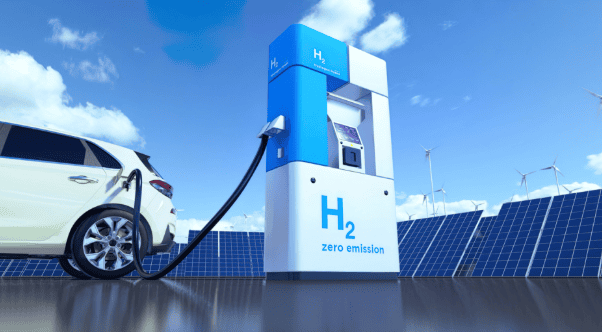
Another major challenge is the availability of hydrogen filling stations.
Unlike conventional petrol stations or the expanding network of EV charging stations, hydrogen refuelling infrastructure remains limited in many parts of the world.
Building hydrogen filling stations requires specialised storage systems, high-pressure equipment, safety controls, and significant investment.
For this reason, hydrogen vehicles may not be practical for drivers living in areas without reliable refuelling facilities.
Before purchasing a fuel cell vehicle, it is essential to confirm that compatible hydrogen refuelling infrastructure is available in the locations where the vehicle will be used.
Important Safety and Maintenance Tips for Hydrogen Vehicle Owners
At MotorGuide, our advice is that anyone planning to purchase or operate a hydrogen fuel cell vehicle should pay special attention to its high-pressure fuel storage and safety systems.
Hydrogen is an extremely lightweight gas and is highly flammable under suitable conditions.
Because of this, hydrogen vehicles are designed with specialised safety systems, including hydrogen leak detection sensors, pressure management devices, and automatic shut-off valves.
These components help control hydrogen flow and reduce the risk of dangerous leaks.
High-pressure storage tanks are also constructed using carefully engineered materials, including carbon-fibre-reinforced structures, to withstand the demanding conditions associated with hydrogen storage.
However, proper maintenance is essential.
Owners should follow the vehicle manufacturer's inspection and maintenance requirements and have hydrogen fuel system components serviced only by qualified professionals.
If the vehicle is involved in an accident, the hydrogen storage system and associated components should be inspected according to the manufacturer's safety procedures before the vehicle is returned to normal use.
Drivers should never attempt to repair high-pressure hydrogen tanks, fuel lines, valves, or related safety equipment themselves.
With the right infrastructure, responsible maintenance, and cleaner hydrogen production methods, fuel cell technology could become an important part of the future transportation industry.
However, it is best understood as one possible solution alongside battery electric vehicles and other low-emission technologies, rather than a guaranteed replacement for all existing vehicle powertrains.
Stay connected with MotorGuide for more useful information about modern automotive technologies, alternative fuel systems, vehicle maintenance, and everything you need to know about the future of transportation.

எழுதியவர்
Nisaga Sandaru
A versatile and highly experienced professional, currently an Automobile undergraduate at the University of Jaffna, with strong technical expertise grounded in hands-on work as a technician with SriLankan Airlines Ground Support Equipment (GSE). Holding an Automobile NVQ Level 3 qualification, along with specialized certifications in Vehicle ECU Programming and Diagnosis, and extensive experience in arc welding and vehicle body painting, and well equipped to handle complex automotive, diagnostic, and fabrication-related tasks with a high level of competence.