What Is e-CVT Technology in Hybrid Vehicles and How Does It Work?

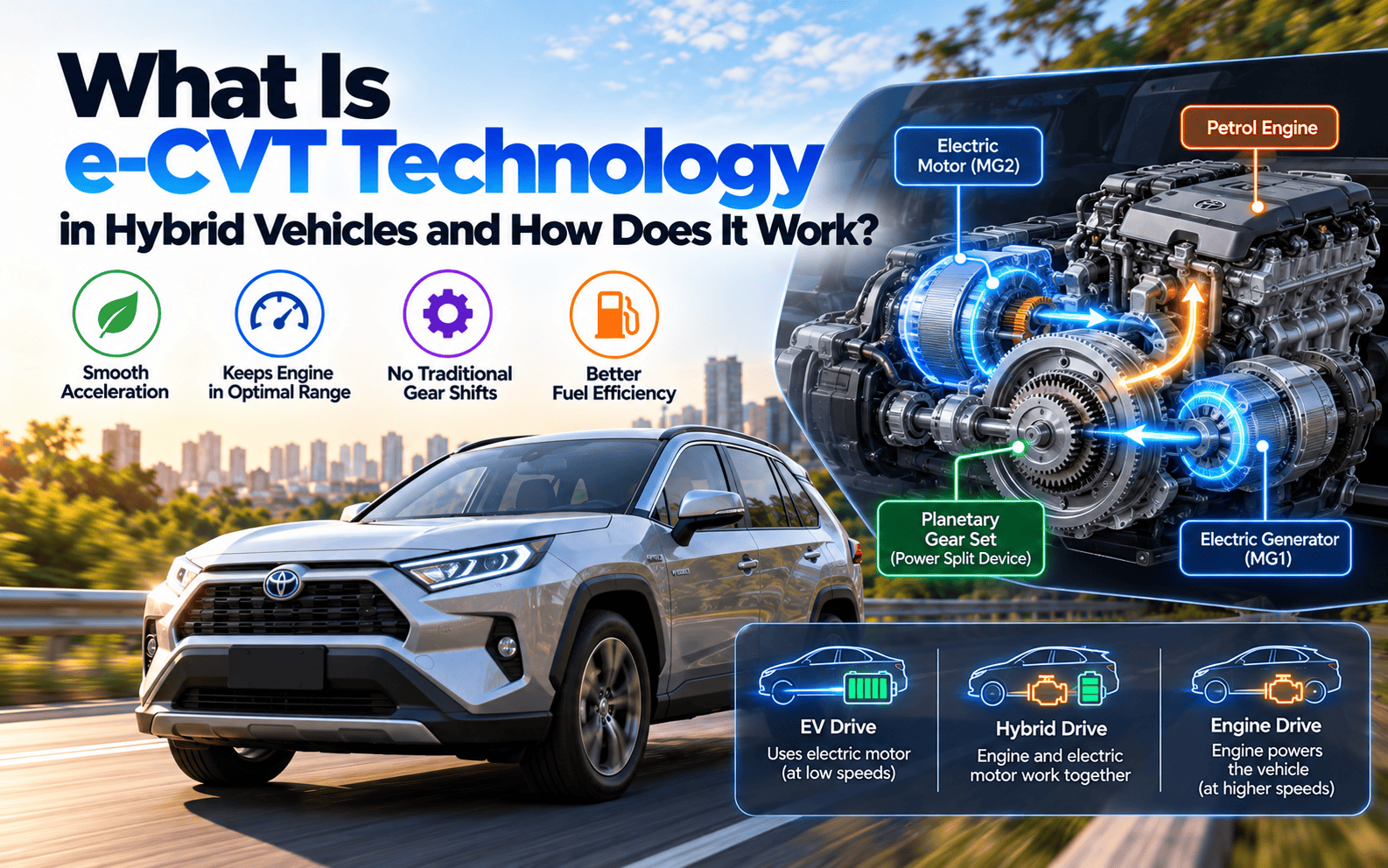
Today at MotorGuide, we're going to explore a transmission technology familiar to many hybrid vehicle owners in Sri Lanka. If you drive a Toyota Aqua, Prius, or Corolla Axio Hybrid, you may already have heard the term e-CVT. However, many drivers aren't entirely sure how this transmission works or how it differs from a conventional automatic gearbox.
Traditional automatic transmissions use mechanical gear arrangements and other components to deliver power to the wheels. Conventional Continuously Variable Transmissions (CVTs), meanwhile, often use variable-diameter pulleys connected by a metal belt or chain.
But the e-CVT found in many Toyota hybrids uses a different approach. It combines a planetary gear mechanism with electric motor-generators and electronic control to manage the power produced by the petrol engine and hybrid system.
So, what exactly is an e-CVT, how does it work, and what are its advantages and maintenance requirements? Let's take a closer look.
What Is an e-CVT?
e-CVT generally stands for Electronically Controlled Continuously Variable Transmission.
In Toyota's hybrid power-split system, an e-CVT provides continuously variable operation without relying on the belt-and-pulley arrangement used by many conventional CVTs.
Instead, it uses a planetary gear set, electric motor-generators, and a sophisticated electronic control system.
In a conventional automatic transmission, several fixed gear ratios may be selected as the vehicle accelerates or slows down.
In Toyota's power-split hybrid system, the petrol engine and electric motor-generators work together to produce the required driving force without conventional stepped gear changes.
This allows the vehicle's control system to manage engine speed and power delivery according to driving conditions.
However, not every transmission marketed as an e-CVT has the same internal construction. Honda hybrid systems, for example, use different mechanical arrangements from Toyota's planetary power-split design.
Understanding this distinction is particularly important when comparing hybrid vehicles or selecting transmission fluid for maintenance.
What Are the Main Components of Toyota's e-CVT?
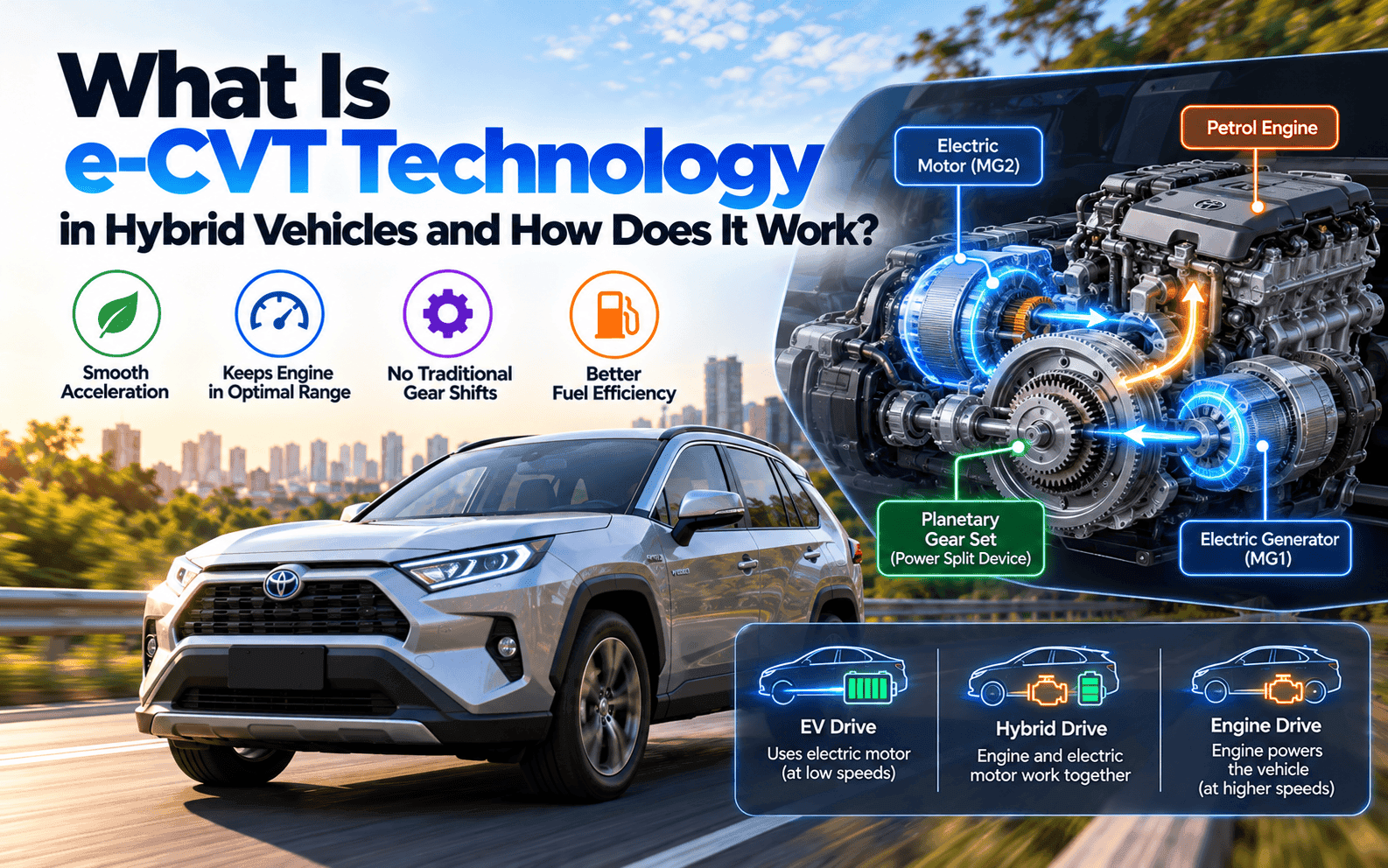
A typical Toyota hybrid power-split system combines a petrol engine, two motor-generators commonly identified as MG1 and MG2, a high-voltage hybrid battery, an electronic power control system, and a planetary gear mechanism.
The petrol engine provides mechanical power and can contribute to generating electricity.
MG1 primarily performs functions such as starting the petrol engine, generating electrical energy, and helping control the relationship between engine speed and drivetrain operation.
MG2 is the main electric traction motor, providing driving force and recovering energy during regenerative braking.
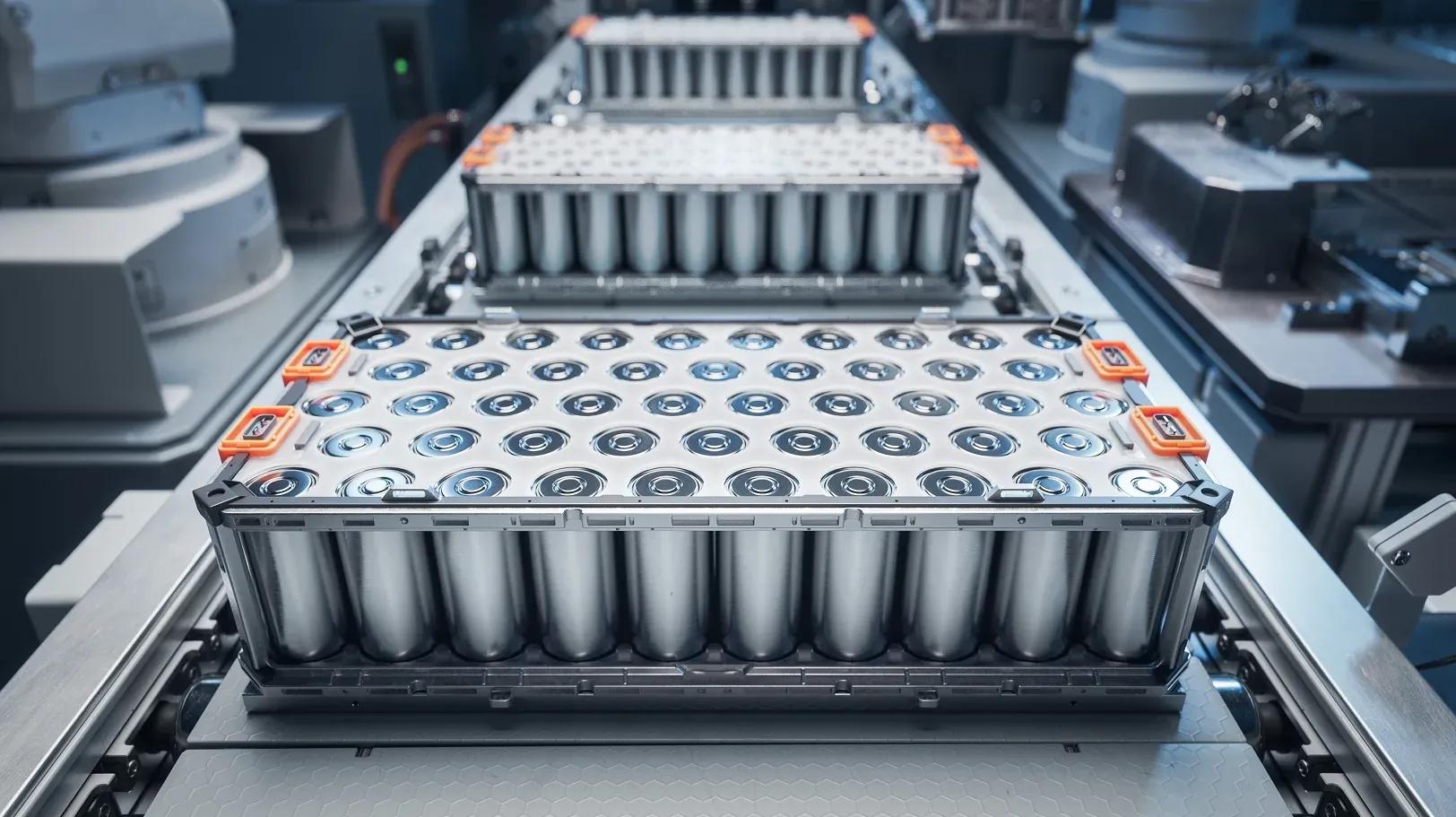
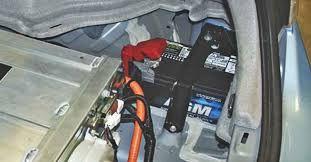
The hybrid battery stores electrical energy that can later be used to power the traction motor.
Depending on the model and production year, Toyota hybrids may use nickel-metal hydride or lithium-ion battery technology.
The planetary gear set provides the mechanical connection that allows the petrol engine and motor-generators to operate together.
This is why a Toyota e-CVT is not simply a gearbox controlled entirely by electronics. It is an electro-mechanical system that combines physical gearing with carefully managed electric motor operation.
How Does the Planetary Gear Set Work?
One of the most interesting parts of Toyota's e-CVT is its planetary gear mechanism.
This assembly contains three main elements: the sun gear at the centre, the planet gears mounted on a carrier, and the surrounding ring gear.
In a commonly used Toyota power-split arrangement, the sun gear is connected to MG1, the planet carrier is connected to the petrol engine, and the ring gear is linked to the output drivetrain and MG2 through the relevant gearing.
These components rotate in a mechanically related manner.
By controlling the speed and electrical load of MG1, the hybrid control system can influence the operating speed of the petrol engine relative to the vehicle's road speed.
MG2 contributes electric driving torque to the wheels when required.
As a result, the drivetrain can provide continuously variable operation without physically shifting between a series of conventional transmission ratios.
This does not mean the system creates an unlimited number of independent mechanical gear ratios. Instead, the fixed planetary gear arrangement and variable motor-generator speeds allow the effective relationship between engine speed and road speed to change continuously within the system's operating limits.
1. Low-Speed Driving and EV Operation
When you start driving a Toyota hybrid at low speed, the vehicle may operate using electric power alone.
Under suitable conditions, the petrol engine can remain switched off while MG2 provides the torque required to move the vehicle.
Electrical energy is supplied by the high-voltage hybrid battery through the power electronics.
This can be particularly useful during slow-moving traffic, parking manoeuvres, and gentle urban driving.
However, the vehicle will not necessarily remain in electric mode every time it travels slowly.
The petrol engine may start depending on battery charge, engine temperature, acceleration demand, cabin heating requirements, and other operating conditions.
2. Acceleration and Combined Power Delivery
When the driver presses the accelerator more firmly, the hybrid system may start the petrol engine and combine its output with electric motor assistance.
In Toyota's power-split arrangement, mechanical power from the engine is distributed through the planetary gear mechanism.
Some of the engine's mechanical power can reach the wheels through the drivetrain, while another portion can drive MG1 to generate electricity.
That electricity may be used to power MG2 or, when operating conditions allow, charge the hybrid battery.
The hybrid battery can also provide additional electrical energy to MG2 during acceleration.
By coordinating these energy flows, the system delivers the torque needed for acceleration while managing engine operation and battery charge.
Importantly, the amount of electricity produced and the direction of energy flow vary continuously according to driving conditions. Power is not always divided into two fixed portions.
3. Highway Cruising and Fuel Efficiency
When travelling at a steady highway speed, the hybrid control system adjusts the operation of the petrol engine and motor-generators to meet the vehicle's power requirements.
Because the system does not rely on conventional stepped gear changes, it can vary the engine's operating speed relatively smoothly.
This provides engineers with flexibility to operate the engine in efficient regions of its operating range whenever practical.
However, the engine does not always operate at one ideal RPM. Its speed depends on driving conditions, power demand, hybrid battery state, and system limitations.
The continuously variable power delivery also eliminates the distinct gearshift events associated with many traditional automatic transmissions.
This helps provide smooth acceleration, although changes in engine speed and vibration may still be noticeable.
4. Regenerative Braking
Another important feature of Toyota's hybrid system is regenerative braking.
When the driver slows down or applies the brakes, MG2 can operate as a generator.
Instead of losing all the vehicle's kinetic energy as heat through the friction brakes, the system converts a portion of that energy into electricity.
The recovered electrical energy is stored in the hybrid battery and can be used again during subsequent driving.
This helps improve overall energy efficiency, particularly in urban driving where braking and acceleration occur frequently.
However, regenerative braking cannot recover all the energy used to move the vehicle, and conventional friction brakes remain essential.
What Are the Advantages of an e-CVT?
One of the biggest advantages of Toyota's power-split e-CVT is its relatively straightforward mechanical arrangement compared with some conventional automatic transmissions.
It does not require the variable pulleys and metal belt used in a traditional belt-driven CVT.
The power-split design also avoids conventional stepped gear changes, contributing to smooth power delivery.
Another advantage is the system's ability to coordinate the petrol engine and electric motor-generators efficiently.
This can reduce unnecessary engine operation during suitable driving conditions and allow the vehicle to recover energy when slowing down.
As a result, hybrid vehicles equipped with this type of transmission can provide excellent fuel economy, particularly in urban traffic.
However, actual efficiency depends on the vehicle model, battery condition, driving environment, and driver behaviour.
Some Toyota hybrids may achieve more than 25 km/L under favourable conditions, but this should not be considered a guaranteed figure for every e-CVT vehicle.
Is an e-CVT More Reliable Than a Conventional CVT?
Toyota's planetary power-split e-CVT has developed a reputation for durability, partly because it does not use a conventional friction belt or pulley system.
The arrangement also avoids some of the components and wear mechanisms found in other automatic transmission designs.
However, the transmission still contains gears, bearings, electric motor-generators, seals, electrical components, and lubrication systems that can develop faults.
Its reliability depends on correct operation, suitable maintenance, manufacturing quality, and the condition of the vehicle.
While some properly maintained hybrid vehicles operate successfully beyond 300,000 kilometres, no manufacturer can guarantee that every e-CVT will remain fault-free for a particular distance.
Does an e-CVT Have a Rubber Band Effect?
Some drivers notice that the petrol engine becomes noticeably louder during strong acceleration, even though the vehicle's speed increases smoothly.
This characteristic is sometimes described as the rubber band effect.
In a conventional stepped transmission, engine speed often rises and falls as gears change.
In an e-CVT, the control system can increase engine RPM to meet power demand without the same relationship between engine speed and fixed gear changes.
As a result, the engine may maintain a relatively high RPM while the vehicle continues accelerating.
This can feel unusual to drivers who are more familiar with conventional automatic or manual transmissions.
However, the sensation is generally a characteristic of the system's operation rather than evidence of transmission belt slippage.
Unusual noises, excessive vibration, warning lights, or a noticeable loss of driving power should still be inspected by a qualified technician.
Is Toyota's e-CVT the Same as Honda's e-CVT?
Although the term e-CVT is used in connection with different hybrid systems, Toyota and Honda do not necessarily use the same transmission design.
Many Toyota hybrids use a planetary power-split device that mechanically combines the operation of the petrol engine and electric motor-generators.
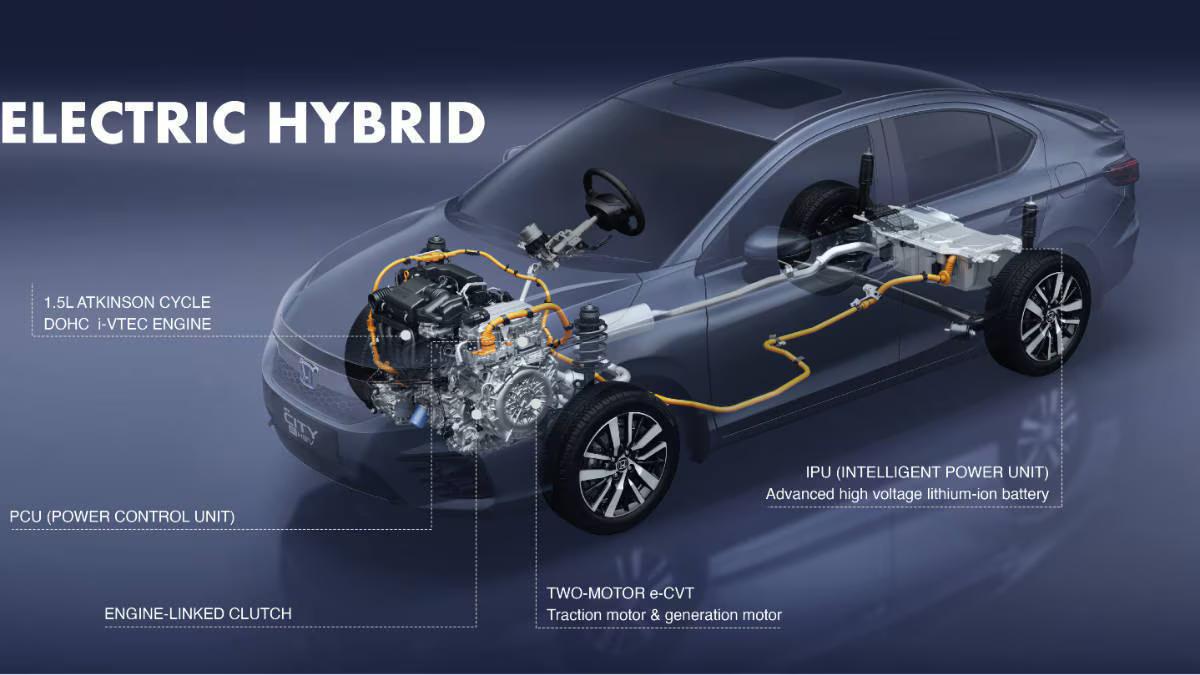
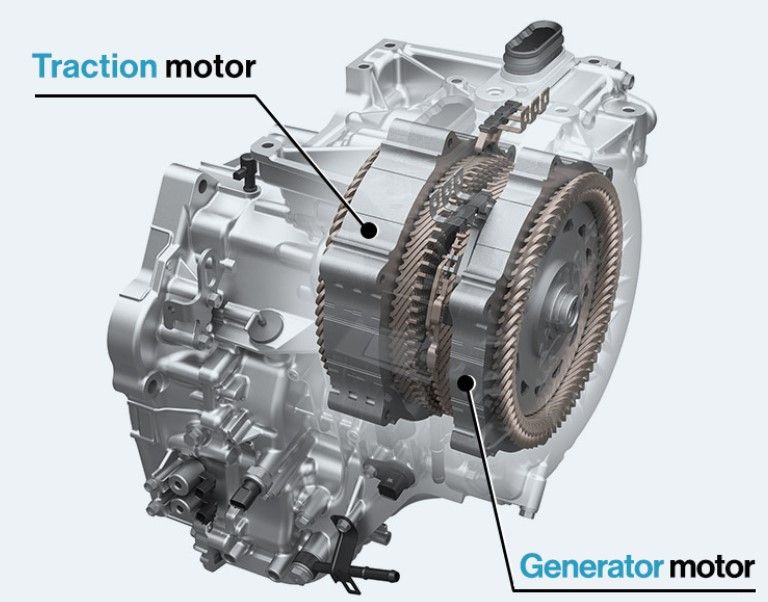
Honda's e:HEV system, used in various modern Honda hybrids, generally relies on an electric traction motor for much of its driving operation.
Depending on the operating conditions, the petrol engine can generate electricity, while a mechanical clutch can connect the engine to the wheels during suitable higher-speed cruising.
This differs from Toyota's planetary power-split arrangement.
Older Honda hybrid transmissions also vary by model and generation, with some using conventional belt-driven CVTs or other transmission designs.
Therefore, it is important not to assume that all hybrid vehicles labelled e-CVT contain the same internal components or require the same maintenance procedures.
How to Maintain an e-CVT Transmission
At MotorGuide, our advice is to follow the transmission maintenance requirements specified for your exact vehicle model and production year.
One important consideration is the correct transmission fluid.
Although Toyota's planetary e-CVT does not use a conventional CVT belt, its internal mechanical and electrical components still operate within a lubricated transmission assembly.
Transmission fluid can help lubricate gears and bearings, protect internal components, and support heat management according to the system's design.
However, not every vehicle requires transmission fluid replacement at the same mileage.
Some owners and workshops recommend preventive fluid changes around 40,000 to 50,000 kilometres, but this is not a universal Toyota or Honda manufacturer requirement.
The appropriate maintenance schedule depends on the exact transmission, driving conditions, and manufacturer's recommendations.
It is equally important to use the correct fluid specification.
For example, Toyota ATF WS is specified for many Toyota hybrid transaxles, but owners should always confirm compatibility using the vehicle's service documentation.
Honda HCF-2 is a fluid intended for specified Honda CVT applications and should not automatically be used in every Honda hybrid transmission.
Modern Honda e:HEV systems may require different transmission fluid specifications depending on the model.
Using an incorrect fluid can affect lubrication, performance, or component durability.
Therefore, before carrying out a fluid change, confirm the transmission type, required fluid specification, recommended quantity, and correct service procedure.
Regular inspections, correct maintenance, and prompt attention to unusual symptoms can help protect the transmission and maintain the vehicle's efficiency.
Overall, e-CVT technology demonstrates how petrol engines, electric motors, and intelligent electronic controls can work together to deliver smooth and efficient driving.
Stay connected with MotorGuide for more useful information about hybrid vehicles, modern transmission technologies, maintenance tips, and everything you need to know about the world of vehicles.

Written by
Nisaga Sandaru
A versatile and highly experienced professional, currently an Automobile undergraduate at the University of Jaffna, with strong technical expertise grounded in hands-on work as a technician with SriLankan Airlines Ground Support Equipment (GSE). Holding an Automobile NVQ Level 3 qualification, along with specialized certifications in Vehicle ECU Programming and Diagnosis, and extensive experience in arc welding and vehicle body painting, and well equipped to handle complex automotive, diagnostic, and fabrication-related tasks with a high level of competence.